
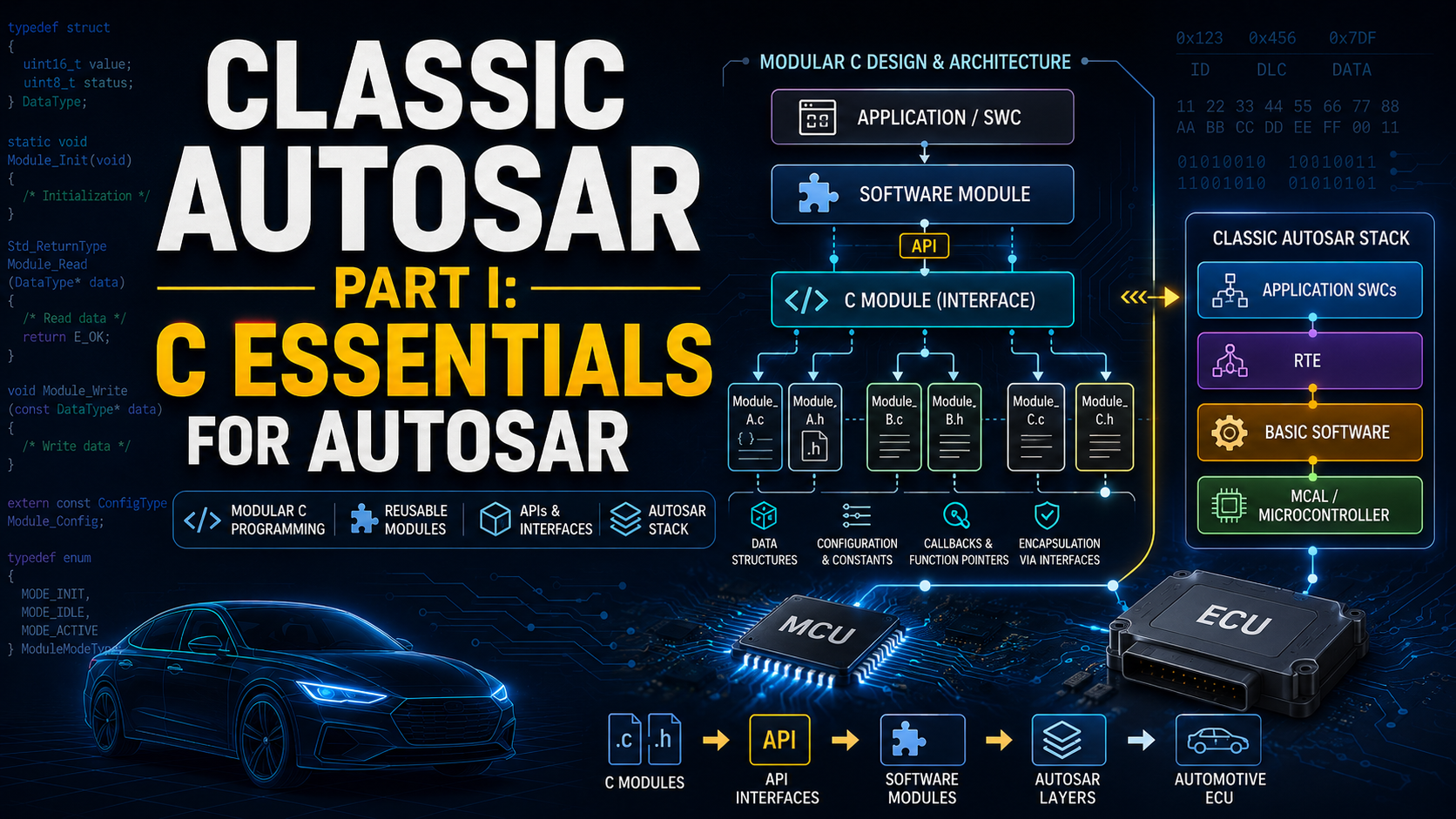
Classic AUTOSAR (Part I): C Essentials
C Essentials for AUTOSAR
This course builds the C-language foundation every AUTOSAR Classic engineer needs — memory model, linker behavior, startup sequence, pointers, type systems, and preprocessor patterns — all grounded in real AUTOSAR conventions and code you’ll actually encounter in production stacks.
By connecting core C fundamentals with AUTOSAR-specific practices like MemMap sections, reentrancy, ISR handling, and MISRA-aligned defensive programming, this course prepares you to read, debug, and write AUTOSAR-compliant C code with confidence.
Bestseller
Beginner
Intermediate
Last Updated: 20 August 2026|
English|
365 days Access.
Includes
~19 Hrs of recorded lectures.
73+ Lessons.
~20+ Project implementation.
Certificate on completion.
AUTOSAR-Focused C Fundamentals
Real Startup and Linker Analysis
Reentrancy and ISR Deep Dive
MISRA-Aligned Defensive Programming
AUTOSAR MemMap Mechanism Example
What you will learn
Understand the C memory model and how it underpins AUTOSAR software design.
Trace the booting sequence and the role of the startup file in embedded systems.
Analyze memory segments and control layout through the linker.
Understand stack memory behavior and how to analyze it in practice.
Master pointer fundamentals, pointer arithmetic, and arrays of pointers.
Apply AUTOSAR-specific pointer and type-system conventions, including typedefs for abstraction.
Use storage classes and type qualifiers the way AUTOSAR code expects.
Master preprocessor directives, conditional compilation, and AUTOSAR versioning schemes.
Design structs for AUTOSAR configuration, including padding, alignment, and bitfields.
Understand unions and iterate safely over arrays of structures.
Understand translation units, linkage basics, and header file practices.
Manage circular dependencies and structure AUTOSAR modules correctly.
Differentiate external and internal linkage in multi-module AUTOSAR projects.
Build function-pointer-based abstractions - dispatch tables, jump tables, strategy and factory patterns.
Implement multiple callbacks per event using observer-style callback arrays.
Master single and multi-level pointer indirection, including const double pointers.
Understand AUTOSAR MemMap mechanisms and code/var/const/config sections.
Apply compiler-specific pragmas and attributes correctly.
Handle multicore scenarios and reentrant function design.
Detect non-reentrant patterns and apply reentrancy guards and critical sections.
Understand ISR categories, ISR vs normal function behavior, and safe early returns from ISRs.
Work with MMIO - volatile usage, typecasting, and bitwise operations for hardware registers.
Pack and unpack signals for protocol data, including AUTOSAR signal protection and endianness handling.
Apply defensive programming and MISRA-C practices - null pointer validation, array bounds, and return value checks.
Details of Content
Part I: C Language Foundations
Introduction to Course
Cautionary Note - Why this Course Exists?
C Memory Model
Tools Setup and Project Folder Structure
Booting Sequence and Role of Startup File
Memory Segment Analysis
Linker Control
Stack Memory Analysis
Pointer Intro
Pointer Arithmetic and Array of Pointers Usage
AUTOSAR Pointers
AUTOSAR Type System
typedef for Abstraction
AUTOSAR Types
Storage Classes Uses in AUTOSAR
Type Qualifiers
C Type Qualifiers
Preprocessor Basics
#ifdef, #ifndef, #if-else
Conditional Compilation
Preprocessor
AUTOSAR Version Schemes
Struct Usage for AUTOSAR Config
Memory Alignment and Struct Padding
Need for Padding Control in AUTOSAR
Use of Bitfields
Unions Usage
Iterating Over Array of Structures
Struct Memory Alignment, Padding, Bitfields
Function Usage
Part II: Advanced C Patterns
Translation Unit in Compilation
Linkage Basics
Header File Practices
Circular Dependency and AUTOSAR Module Arrangement
External/Internal Linkage
Function Pointer Basics
Function Pointers
Passing Function as Argument - Strategy, Factory Pattern
Dispatch Table and Jump Table
FnPtr Structure and Virtual Tables
Multiple Callbacks for Same Event
Observer Patterns - Callback Arrays
Single Indirection Recap
Multi Indirection with Examples
Const Double Pointer
Null Handling and Reordering Pattern
Multilevel Indirection
Part III: AUTOSAR-Specific Patterns
AUTOSAR MemMap Mechanism
Code, Var, Const and Config Sections
Compiler Specific Pragmas and Attributes
Multicore Scenarios
AUTOSAR MemMap
Reentrant Functions Properties
Non-Reentrant Vs Reentrant Functions
Concept of Critical Section
Detecting Non-Reentrant Patterns
Reentrancy Guard
Interrupt Service Routine Basics
ISR Categories in AUTOSAR
ISR Vs Normal Function
Exit Interrupt and Early Return from ISR
Critical Section
MMIO Basics
Use of 'volatile' for Accessing HW Register
Typecasting for MMIO
Bitwise Operations for HW Registers
Signal Packing and Unpacking for Protocol Data
AUTOSAR Signal Protection Mechanism
GPIO Endianness Demo
Defensive Programming - Null Ptr Validation
Defensive Programming - Array Bound Violation
Defensive Programming - Problem with Ignoring Return Value
MISRA C / Defensive Programming
What sets this apart?
AUTOSAR-Focused C Fundamentals
Real Startup and Linker Analysis
Memory-Centric Teaching
Reentrancy and ISR Deep Dive
MISRA-Aligned Defensive Programming
Tool-Driven Engineering Approach
Production-Oriented Problem Solving
Mental Model Development
Sample Certificate
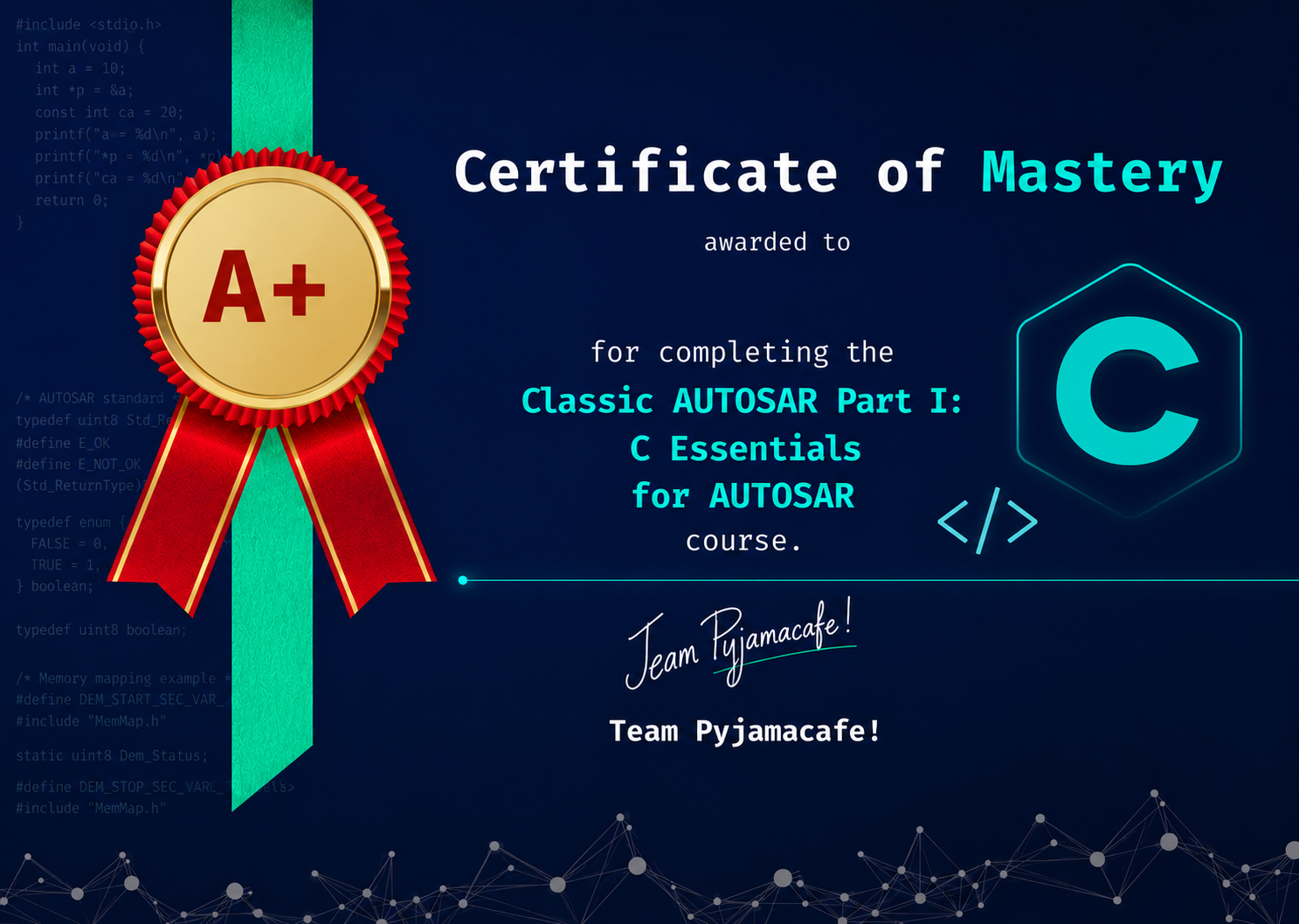
Earn a certificate for every technical track by completing 95% of the course work.
Instructors

Jegan is an Automotive Embedded Systems/Software trainer holding a Master's degree in Automotive Electronics, with 14+ years of experience spanning academia and industry. In academia, served as Assistant Professor teaching Automotive Control Systems, Electric Hybrid Vehicles, and Vehicle Dynamics while establishing a research laboratory for Rapid Control Prototyping and Hardware-in-the-Loop simulation. Guided a Formula Student electric race car project competing at international events in Italy and India.
In industry, progressed through senior roles designing competency frameworks for automotive business units, leading Model-Based Development tools creation, and managing technical delivery across diverse client segments. Currently leading the Embedded and Automotive track within a global talent development function, shaping the next generation of automotive software professionals.
Research interests focus on control strategy development for autonomous vehicles, vehicle dynamics and control, modern automotive software architectures, and vehicle software development. Continues serving on academic boards for automotive electronics programs, bridging industry innovation with academic excellence.
Audience
Embedded and Systems Engineers: Developers working on firmware, RTOS, drivers, and low-level software who want a strong C foundation aligned with AUTOSAR Classic conventions.
AUTOSAR SWC and BSW Developers: Engineers building software components and basic software modules who need to read and write AUTOSAR-compliant C code confidently.
C Developers Aiming for Automotive Roles: Programmers who know core C and want to transition into automotive and AUTOSAR-based embedded development.
Students from Electrical, Electronics and Computer Science Engineering disciplines
Requirements
Basic understanding of C-Programming (with understanding of pointers, structures)
FAQs
Why is this course not included in the Library Access?
This course is created and delivered by a partner who is not a core member of the Pyjama Cafe team. We need to compensate the partner based on the sales of their content.
Is this recommended for beginners?
Yes! The courses are taught as if the learner has no idea about the subject.
Do I need a special machine configuration to take this course?
No!
Can I change my email-id post purchase?
As much as we’d like to support that, your account will be linked to your email-id post purchase.
What name will be printed on the Certificate?
The name you use on the platform will be printed as is on the Certificate when it is generated.
Bestseller
Beginner
Intermediate