
Classic AUTOSAR PART III: Basic Software (BSW) Integration.
Communication, Memory, Diagnostics, Crypto and MCAL Stacks in Classic AUTOSAR
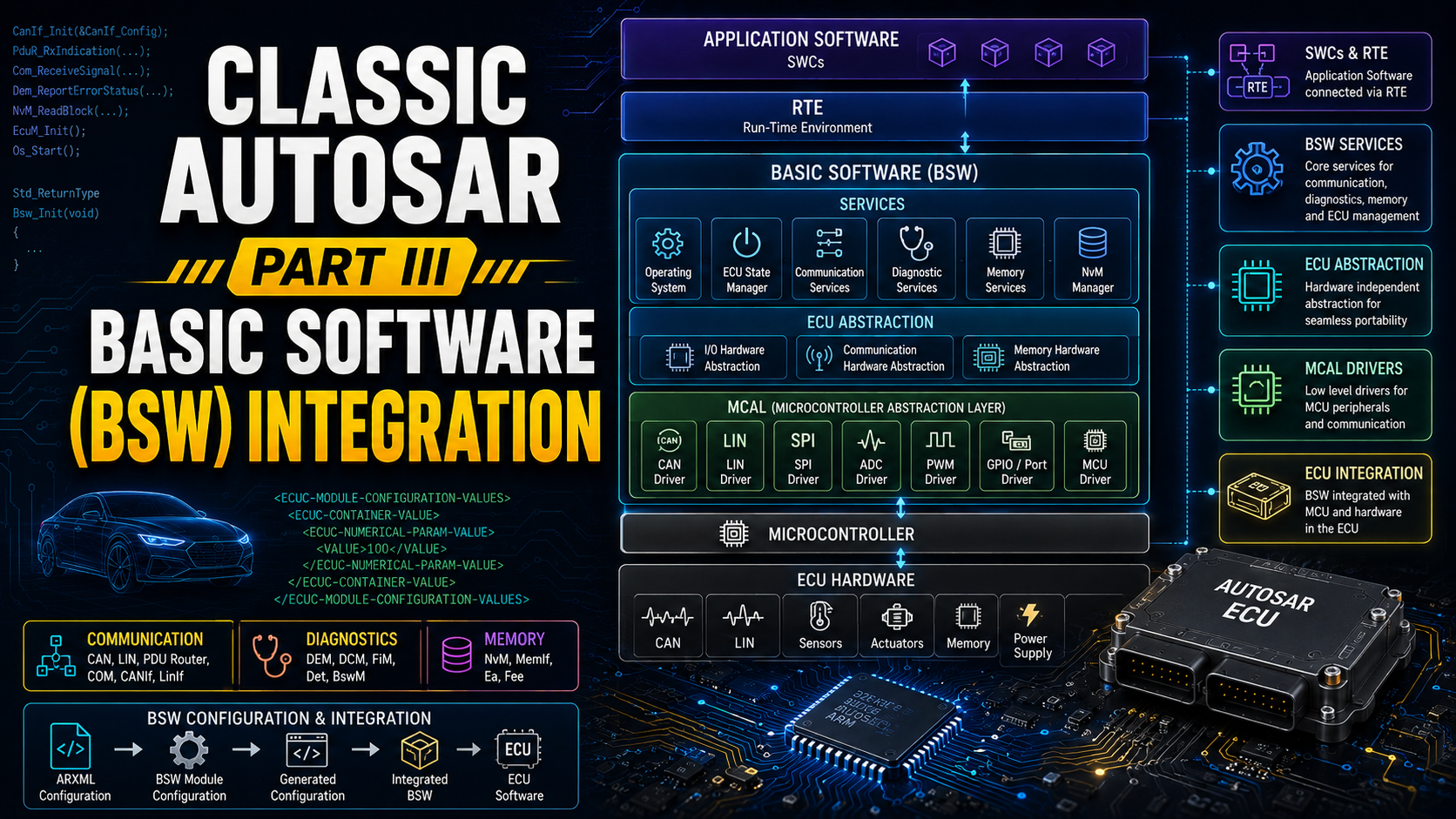
This course takes you through the Basic Software layer of Classic AUTOSAR end to end — OS services, the communication stack, ECU state management, the memory stack, diagnostics, the crypto stack with SecOC, and MCAL — connecting architecture to real ARXML configuration at every stage.
By working through module interactions, configuration workflows, and real-world data flows across BSW, this course prepares you to integrate, configure, and debug AUTOSAR Basic Software with confidence.
Bestseller
Intermediate
Advanced
Last Updated: 20 August 2026|
English|
365 days Access.
Includes
~19 Hrs of recorded lectures.
40+ Lessons.
~20+ Project implementation.
Certificate on completion.
Full BSW Stack Coverage
Real ARXML Configuration Walkthroughs
Diagnostics and Cryptography Deep Dive
MCAL and Driver-Level Grounding
What you will learn
Understand AUTOSAR architecture from an ICC and configuration-class perspective.
Classify BSW modules and apply BSW interaction rules correctly.
Understand AUTOSAR OS alarms, schedule tables, event mechanisms, timing, memory protection, and multicore OS features.
Understand the AUTOSAR ComStack architecture, PDU terminology, and CAN frame structure.
Work through CAN Driver, CAN Interface, and CAN Transport Protocol (ISO 15765-2) behavior in detail.
Trace PDU routing paths and configure the COM module and COM stack via ARXML.
Understand signal packing, endianness, COM transfer properties, update bits, and COM filtering.
Understand IPDU groups, IPDU multiplexing, and signal gateway concepts.
Understand COMM and Network Management (NM) basics, and LIN/Ethernet stack architecture.
Understand EcuM and BswM, and the EcuM state machine.
Trace EcuM startup/shutdown sequences, wakeup sources, and sleep modes.
Configure BswM completely and compare BswM vs EcuM mode management.
Understand the memory stack architecture and the EEPROM path.
Understand NVM block types, basic storage objects, and the NVM API.
Configure NVM job processing, callbacks, and ARXML settings.
Understand MemIF, FEE, EA, and memory driver relationships.
Trace a full memory stack read/write flow with ARXML configuration.
Understand diagnostics architecture - UDS over CAN and ISO 14229 services.
Understand session management, security access, and other diagnostic services.
Understand DCM internal architecture, buffer handling, multi-request protocol, and timing parameters.
Configure DCM and trace diagnostic flow and integration scenarios.
Understand DEM architecture, core functionality, and DTC examples.
Understand event debouncing, event reporting, event memory, aging, freeze frames, and extended data records.
Understand DEM interfaces, OBD in DEM, and FIM.
Understand UDS flash programming and the flashing workflow.
Understand the Crypto Stack architecture, automotive use cases, and the CSM lifecycle.
Understand AES, hash functions, and MAC generation and verification.
Understand RSA (asymmetric) key management.
Configure CryIF and Crypto Driver, and get introduced to SecOC.
Understand why SecOC is needed and its architecture.
Understand SecOC TX and RX flows.
Understand the Freshness Value Manager (FVM) strategy.
Configure secure IPDU layout and SecOC-COM integration via ARXML.
Get an overview of MCAL - drivers, standards, architecture, and the Port/DIO driver.
Understand the ADC driver and other MCAL modules.
Consolidate the full BSW picture and plan a learning roadmap forward.
Details of Content
AUTOSAR OS and BSW Architecture
AR Architecture - ICC, Configuration Classes
BSW Module Classification, BSW Interaction Rules
AR OS - Alarm / Schedule Tables
AR OS - Event Mechanism, Timing, Memory Protection, Multicore OS Features
Communication Stack
AR ComStack Architecture, PDU Terminology, CAN Frame Walkthrough
CAN Driver, CAN IF and CAN TP Overview
CAN TP in Detail (ISO 15765-2)
PDU Routing Path, COM Module, COM Stack - ARXML Config
Signal Packing and Endianness
COM Transfer Properties, Update Bits and COM Filtering
IPDU Groups / IPDUM / Signal Gateway
COMM and NM Basics
LIN/Ethernet Stack Architecture
ECU State Management
EcuM, BswM and EcuM State Machine - Overview
EcuM Startup/Shutdown Sequence - Wakeup Source, Sleep Modes
BswM Complete, BswM Vs EcuM Mode Management Config - Summary
Memory Stack
MemStack Architecture - EEPROM Path
NVM Block Types / Basic Storage Object / NVM API
NVM Job Processing / Callback / ARXML Configuration
MemIF / FEE / EA / Memory Drivers
Full Memory Stack RW Flow / ARXML Config
Diagnostics (UDS, DCM, DEM)
Diagnostics Architecture - UDS over CAN, ISO 14229 Services
Session Management, Security Access and Other Diag Services
DCM Internal Architecture, DCM Buffer Handling, DCM Multireq Protocol, DCM Timing Params
Configure DCM
DEM Architecture, Core Functionality, DTC Examples
Event Debouncing, Event Reporting, Event Memory, Aging, Freeze Frame and Extended Data Records
DEM Interfaces, OBD in DEM, FIM
UDS Flash Programming, ARXML Config and Workflow
Crypto Stack and SecOC
Cryptostack Architecture, Automotive Use Cases, CSM Lifecycle
AES Explained, Hash Function, MAC Generation and Verification
RSA (Asymmetric) Key Management
CryIF Config, Crypto Driver Config / SecOC Intro (Optional)
Why SecOC, SecOC Architecture
SecOC - TX, RX
FVM (Freshness Value Manager) Strategy
Secure IPDU Layout, SecOC COM Integration, ARXML Config
MCAL and Wrap-Up
MCAL Overview - Drivers, Standards, Architecture, Port/DIO Driver
ADC Driver - Other MCAL Modules
Summary and Road Map
What sets this apart?
Full BSW Stack Coverage
Real Configuration Walkthroughs
Diagnostics and Cryptography Deep Dive
MCAL and Driver-Level Grounding
Case-Study Based Teaching
Production-Oriented Problem Solving
Mental Model Development
Sample Certificate
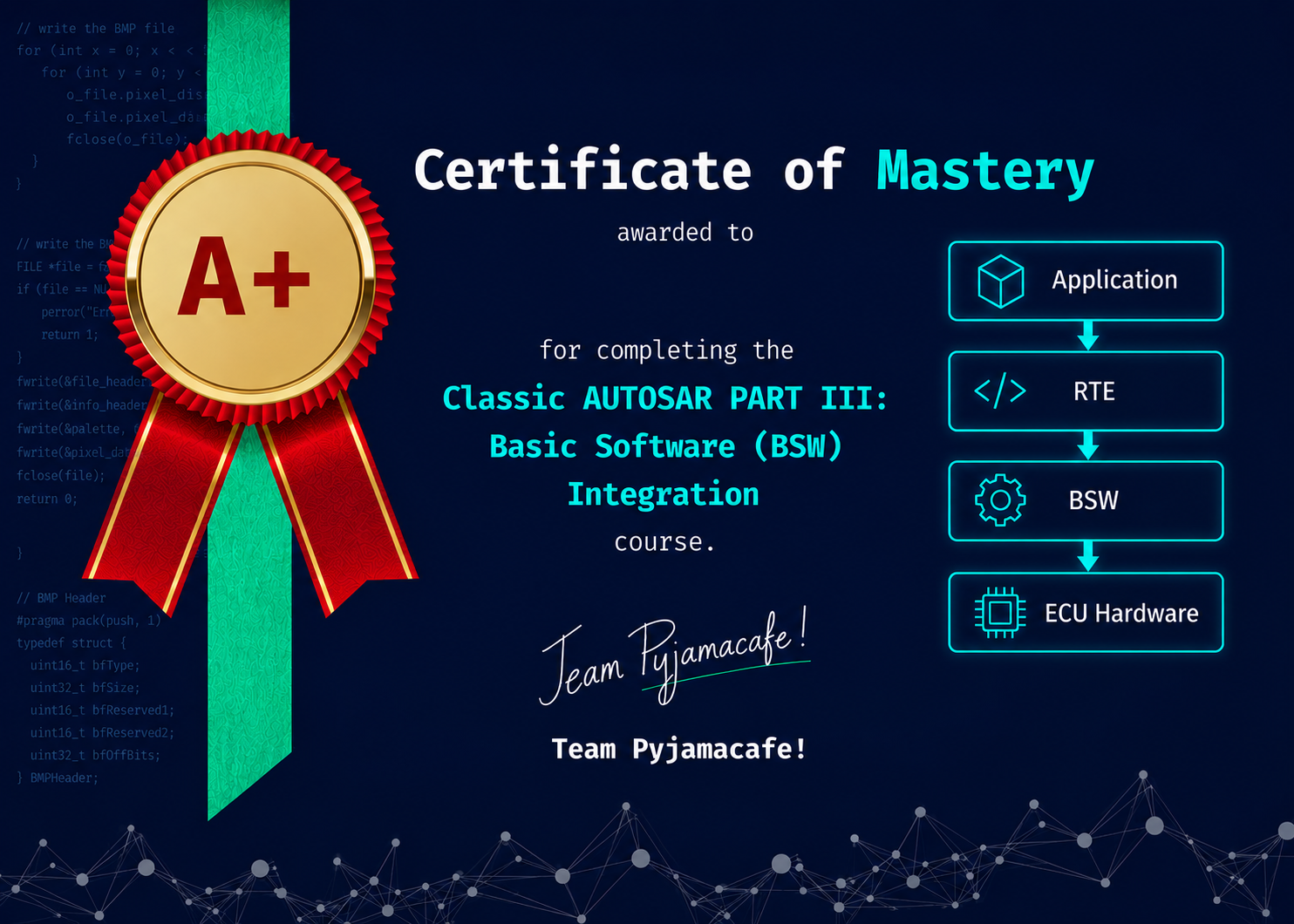
Earn a certificate for every technical track by completing 95% of the course work.
Instructors

Jegan is an Automotive Embedded Systems/Software trainer holding a Master's degree in Automotive Electronics, with 14+ years of experience spanning academia and industry. In academia, served as Assistant Professor teaching Automotive Control Systems, Electric Hybrid Vehicles, and Vehicle Dynamics while establishing a research laboratory for Rapid Control Prototyping and Hardware-in-the-Loop simulation. Guided a Formula Student electric race car project competing at international events in Italy and India.
In industry, progressed through senior roles designing competency frameworks for automotive business units, leading Model-Based Development tools creation, and managing technical delivery across diverse client segments. Currently leading the Embedded and Automotive track within a global talent development function, shaping the next generation of automotive software professionals.
Research interests focus on control strategy development for autonomous vehicles, vehicle dynamics and control, modern automotive software architectures, and vehicle software development. Continues serving on academic boards for automotive electronics programs, bridging industry innovation with academic excellence.
Audience
BSW Developers and Integrators: Engineers configuring and integrating AUTOSAR Basic Software modules across communication, memory, diagnostics, and crypto stacks.
Diagnostics and Security Engineers: Engineers working on UDS, DEM/DCM, or SecOC/crypto stack implementations.
Embedded and Systems Engineers: Developers moving from application-level AUTOSAR work into BSW configuration and integration.
Students from Electrical, Electronics and Computer Science Engineering disciplines
Requirements
Basic understanding of C-Programming (with understanding of pointers, structures)
Familiarity with Classic AUTOSAR architecture and methodology (Part I and Part II recommended)
FAQs
Why is this course not included in the Library Access?
This course is created and delivered by a partner who is not a core member of the Pyjama Cafe team. We need to compensate the partner based on the sales of their content.
Is this recommended for beginners?
Yes! The courses are taught as if the learner has no idea about the subject.
Do I need a special machine configuration to take this course?
No!
Can I change my email-id post purchase?
As much as we’d like to support that, your account will be linked to your email-id post purchase.
What name will be printed on the Certificate?
The name you use on the platform will be printed as is on the Certificate when it is generated.
Bestseller
Intermediate
Advanced