
Classic AUTOSAR (Part II): Architecture and Application Development
Architecture, Methodology and MetaModels of Classic AUTOSAR.
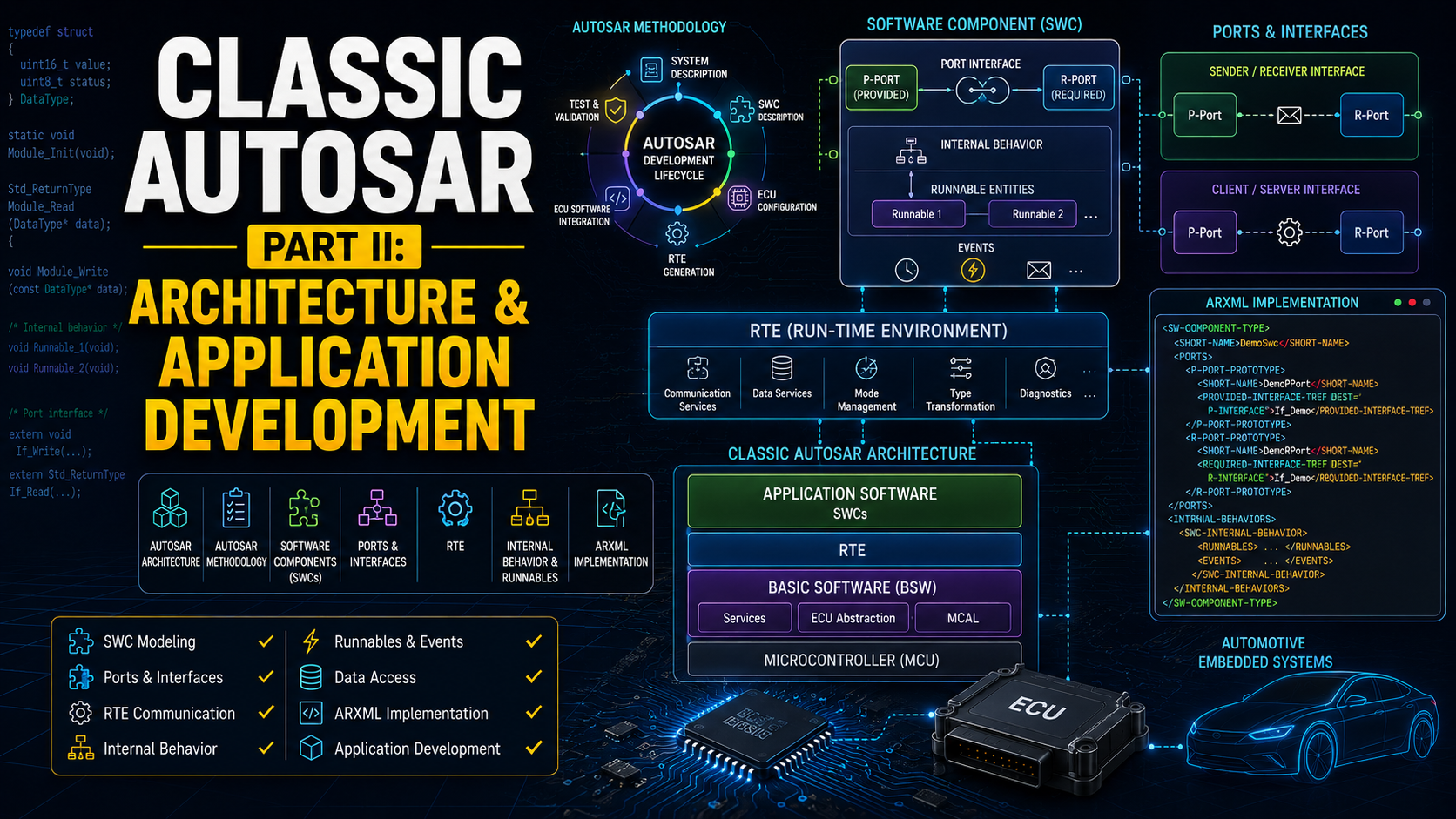
This course builds a ground-up understanding of Classic AUTOSAR — why it exists, how the ecosystem and documentation are organized, how the development methodology actually works, and how the metamodel and ARXML underpin every tool and workflow you’ll use.
By walking through layered architecture, VFB, ports and interfaces, SWC types, and runnable/RTE internals with demos and case studies, this course prepares you to read, configure, and reason about AUTOSAR-based software with confidence.
Bestseller
Beginner
Intermediate
Last Updated: 20 August 2026|
English|
365 days Access.
Includes
~15+ Hrs of recorded lectures.
62+ Lessons.
~20+ Project implementation.
Certificate on completion.
Architecture-First Learning
Real ARXML and Metamodel Walkthroughs
RTE and Runnable Internals
Demo-Driven, Tool-Based Approach
What you will learn
Understand why AUTOSAR exists and what legacy development problems it solves.
Trace the evolution from OSEK/VDX to Classic AUTOSAR and map the inherited concepts.
Understand the AUTOSAR Consortium’s role and the layered AUTOSAR architecture.
Understand BSW structure at a high level and trace a CAN dataflow example end to end.
Navigate AUTOSAR documentation and the AUTOSAR data-exchange format.
Understand the practical workflow of NVM within the AUTOSAR ecosystem.
Understand the AUTOSAR development flow and configuration classes.
Understand RTE generation and top-down, bottom-up, and round-trip workflows.
Differentiate the AUTOSAR tool chain landscape, authoring tools vs BSW tools, and static vs generated code.
Set up an AUTOSAR metamodel environment and use autosarfactory for hands-on modelling.
Understand AUTOSAR application datatype categories and configurations.
Understand implementation datatypes, base types, and data prototypes with hands-on data type modelling.
Understand AUTOSAR metamodel fundamentals and ARXML design principles/model hierarchy.
Understand the Virtual Functional Bus (VFB), ports, and component prototypes.
Master AUTOSAR interface types - Sender-Receiver, Client-Server, Parameter, NV, Mode-Switch, and Trigger.
Work through complete interface integration examples and interface design demos.
Understand SWC types, including Complex Device Drivers (CDD), and port modelling.
Understand connector types and best practices, including assembly and delegation connectors.
Understand runnable entities and internal behavior, including their C implementation.
Master Inter-Runnable Variables (IRV), Exclusive Areas, and Per-Instance Memory (PIM).
Work through a speed-controller case study covering runnable/event relationships and all RTE event types.
Understand DRE, Error Events, OIE, Init Events, Mode-Switch Events, Internal Trigger Events, and Background Events.
Understand event scheduling, event type selection, and the asynchronous client-server pattern.
Apply the RTE API for interfacing and defensive error-handling patterns.
Generate RTE and inspect the resulting C code skeleton through hands-on demos.
Details of Content
Birth and Objectives of AUTOSAR: Understanding Why AUTOSAR Exists and What Problems It Solves
Introduction to the Course
SW Evolution in Automotive
AUTOSAR - Successor of OSEK/VDX
Legacy Development Problems
AUTOSAR Solution for Legacy Challenges
OSEK OS Features
OSEK Vs Classic AUTOSAR - Inheritance Map
AR Consortium Roles
AUTOSAR Layered Architecture
BSW Structure - Function at High Level
CAN Dataflow - Example
AR Layers Stripped - Animation Video
Expected Outcomes from Classic AR
Overview of AUTOSAR Org: Navigating the AUTOSAR Ecosystem and Understanding Document Organization
AR Documentation
Practical Workflow of NVM
AR Data Exchange Format
AUTOSAR Methodology: Understanding How AUTOSAR-Based Development Actually Works
AR Development Flow Based on Methodology
AR Configuration Classes
RTE Generation
Top-Down, Bottom-Up and Round-Trip Workflows
AR Tool Chain Landscape
Authoring Tools Vs BSW Tools
Static and Generated Code
Real World Application Integration & Summary
AUTOSAR MetaModels: Understanding the Foundation That Makes Everything Work
Demo: Environment Setup & autosarfactory Intro
Demo: Autosar Factory - Usage
AR Application Datatypes - Categories
AR Application Datatypes - Configurations
Implementation Datatype / Base Types / Data Prototypes
Demo: Data Type Modelling
AR MetaModel - Fundamentals
ARXML Design Principles - Model Hierarchy
AR Metamodel Documentation
Building Blocks of AUTOSAR SWC: The Fundamental Elements of Application Architecture
Introduction to VFB
Ports & Component Prototype
Interface Type (SR, CS, Param, NV, MS, Trigger)
Complete Integration Example
AR Interfaces Example I (SR)
AR Interfaces Example II (CS)
AR Interfaces Example III (MS)
AR Interfaces Example III (Other Interfaces, Best Practices)
Demo: Interface Design
SWC Types I
SWC Types II (CDD and Others)
Demo: SWC Types & Port Modelling
Connector Types / Best Practices
Demo: Assembly & Delegation Connectors
Software Component Internals: From Architecture to Behavior and Code
AR Runnable Entities - Internal Behaviour
AR Runnables C Implementation
IRV, Exclusive Area and PIM
Speed Controller - Case Study
Relationship Between Runnable/Events - All Possible RTE Events
DRE / Error Event / OIE
Init Event / Mode Switch Event / Internal Trigger Event / BG Event
Event Scheduling, Event Type Selection, Async Client Server Pattern / Event Summary
Demo: Internal Behaviour - Runnables
Demo: Inter-Runnable Variables (IRV)
Demo: Exclusive Areas
Demo: Per-Instance Memory (PIM)
RTE API for Interfacing
Defensive Error Handling Pattern
Demo: RTE Generation & C Code Skeleton
What sets this apart?
Architecture-First Learning
Real ARXML and Metamodel Walkthroughs
RTE and Runnable Internals
Demo-Driven, Tool-Based Approach
Case-Study Based Teaching
Production-Oriented Problem Solving
Mental Model Development
Sample Certificate
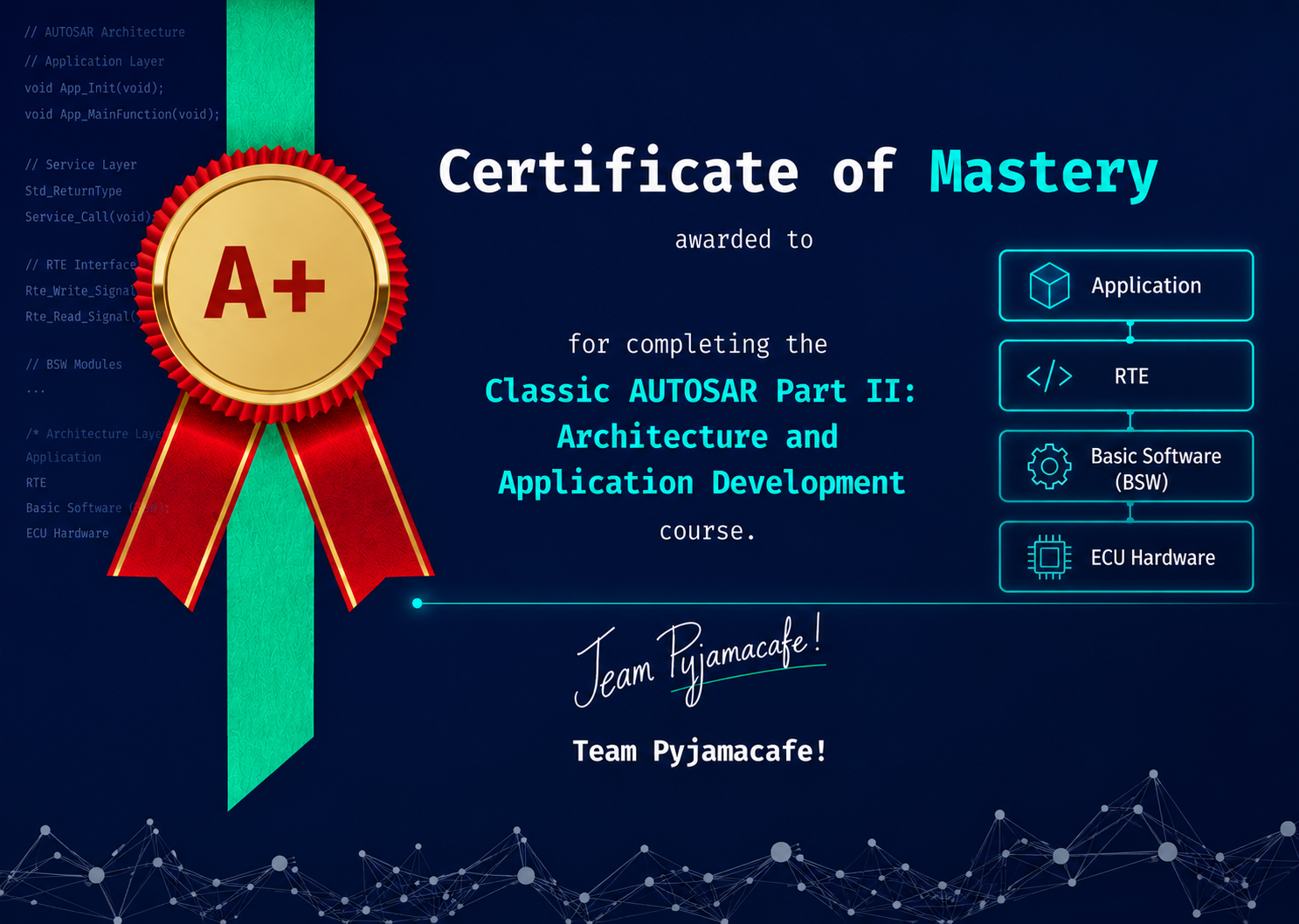
Earn a certificate for every technical track by completing 95% of the course work.
Instructors

Jegan is an Automotive Embedded Systems/Software trainer holding a Master's degree in Automotive Electronics, with 14+ years of experience spanning academia and industry. In academia, served as Assistant Professor teaching Automotive Control Systems, Electric Hybrid Vehicles, and Vehicle Dynamics while establishing a research laboratory for Rapid Control Prototyping and Hardware-in-the-Loop simulation. Guided a Formula Student electric race car project competing at international events in Italy and India.
In industry, progressed through senior roles designing competency frameworks for automotive business units, leading Model-Based Development tools creation, and managing technical delivery across diverse client segments. Currently leading the Embedded and Automotive track within a global talent development function, shaping the next generation of automotive software professionals.
Research interests focus on control strategy development for autonomous vehicles, vehicle dynamics and control, modern automotive software architectures, and vehicle software development. Continues serving on academic boards for automotive electronics programs, bridging industry innovation with academic excellence.
Audience
AUTOSAR SWC and BSW Developers: Engineers who need a solid grounding in AUTOSAR architecture, methodology, and metamodels before diving into component and RTE development.
Embedded and Systems Engineers: Developers moving from general embedded/firmware work into the AUTOSAR ecosystem.
Tool and Integration Engineers: Engineers working with ARXML, authoring tools, and RTE generation who need a strong conceptual foundation.
Students from Electrical, Electronics and Computer Science Engineering disciplines
Requirements
Basic understanding of C-Programming (with understanding of pointers, structures)
FAQs
Why is this course not included in the Library Access?
This course is created and delivered by a partner who is not a core member of the Pyjama Cafe team. We need to compensate the partner based on the sales of their content.
Is this recommended for beginners?
Yes! The courses are taught as if the learner has no idea about the subject.
Do I need a special machine configuration to take this course?
No!
Can I change my email-id post purchase?
As much as we’d like to support that, your account will be linked to your email-id post purchase.
What name will be printed on the Certificate?
The name you use on the platform will be printed as is on the Certificate when it is generated.
Bestseller
Beginner
Intermediate