
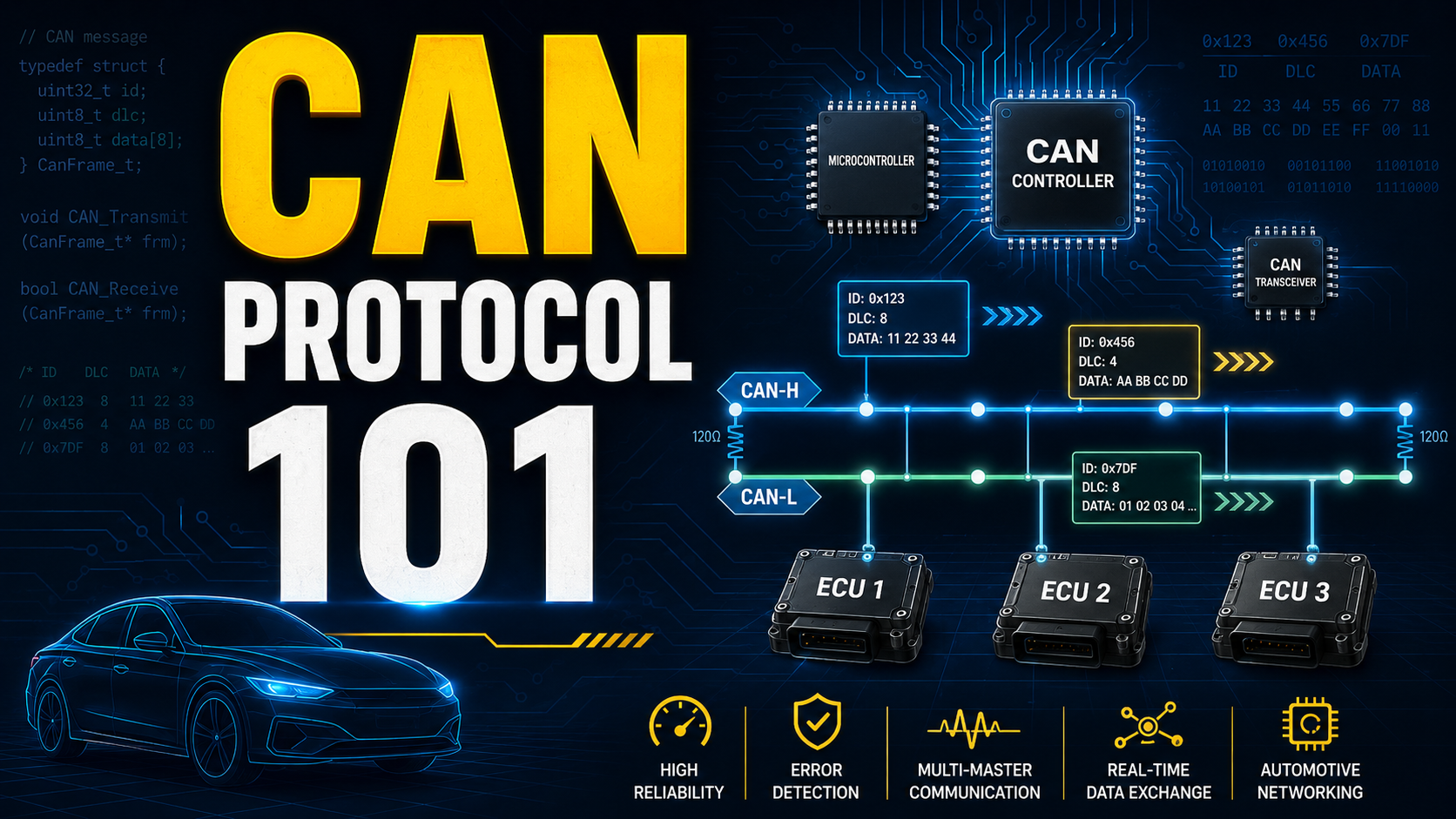
CAN Protocol 101.
Foundations of the Controller Area Network Protocol
This course builds a ground-up understanding of the CAN protocol — from network topology and bit timing to framing, arbitration, error handling, and CAN FD — the foundation every automotive and embedded communications engineer needs.
By connecting bus-level electrical behavior with frame structure, error detection, and protocol state machines, this course prepares you to read CAN traces, debug bus issues, and reason confidently about CAN-based systems.
Bestseller
Beginner
Last Updated: 20 August 2026|
English|
365 days Access.
Includes
~2+ Hrs of recorded lectures.
25+ Lessons.
Certificate on completion.
Bus-Level Fundamentals
Complete Frame Structure Coverage
Error Detection and State Machine Deep Dive
CAN FD Explained
What you will learn
Understand CAN network topology, including nodes, controllers, transceivers, and the bus.
Understand CAN bus voltage levels and dominant/recessive logic.
Understand the CAN communication principle end to end.
Understand bit segments, time quanta, and baud rate calculation.
Understand hard synchronization at Start of Frame (SOF) and resynchronization using the Synchronization Jump Width (SJW).
Understand CAN frame types and the structure of Standard and Extended Data Frames.
Understand addressing and acceptance filtering.
Understand bit stuffing and why it’s needed.
Understand the Remote Frame, Error Frame, and Overload Frame.
Understand Positive and Negative Acknowledgement behavior.
Understand bitwise arbitration and how bus access is resolved.
Understand Bit Error detection, including CSMA/CD behavior.
Understand Stuff Error, CRC Error, Form Error, and ACK Error detection.
Understand NRZ coding and twisted-pair signaling for data protection.
Understand bus termination and its role in signal integrity.
Understand error handling, error tracking, and the CAN error state machine, including the Babbling Idiot scenario.
Understand why CAN FD exists and the problems it solves.
Understand the Bit Rate Switch (BRS) mechanism.
Understand the 64-byte payload and DLC encoding in CAN FD.
Understand CRC-17/21 and the Error State Indicator in CAN FD.
Details of Content
Module 1: CAN Communication
Network, Node, Controller, Transceiver, Bus
CAN Bus Levels & Logic
Communication Principle
Module 2: Bit Timing & Synchronization
Bit Segments, Time Quanta & Baud Rate
Hard Sync at SOF & Resync (SJW)
Module 3: CAN Framing
Frame Types & Data Frame (Standard / Extended)
Addressing & Acceptance Filters
Bit Stuffing
Remote Frame
Error Frame
Overload Frame
Acknowledgement (Positive / Negative)
Module 4: CAN Bus Access
Bitwise Arbitration
Module 5: CAN Error Detection
Bit Error (Including CSMA/CD)
Stuff Error
CRC Error
Form Error
ACK Error
Module 6: CAN Data Protection
NRZ Coding & Twisted Pair
Bus Termination
Error Handling, Tracking & State Machine (Including the Babbling Idiot Scenario)
Module 7: CAN FD
Why CAN FD Exists
Bit Rate Switch (BRS)
64-Byte Payload & DLC Encoding
CRC-17/21 & Error State Indicator
What sets this apart?
Bus-Level Fundamentals
Complete Frame Structure Coverage
Error Detection and State Machine Deep Dive
CAN FD Explained
Mental Model Development
Production-Oriented Problem Solving
Sample Certificate
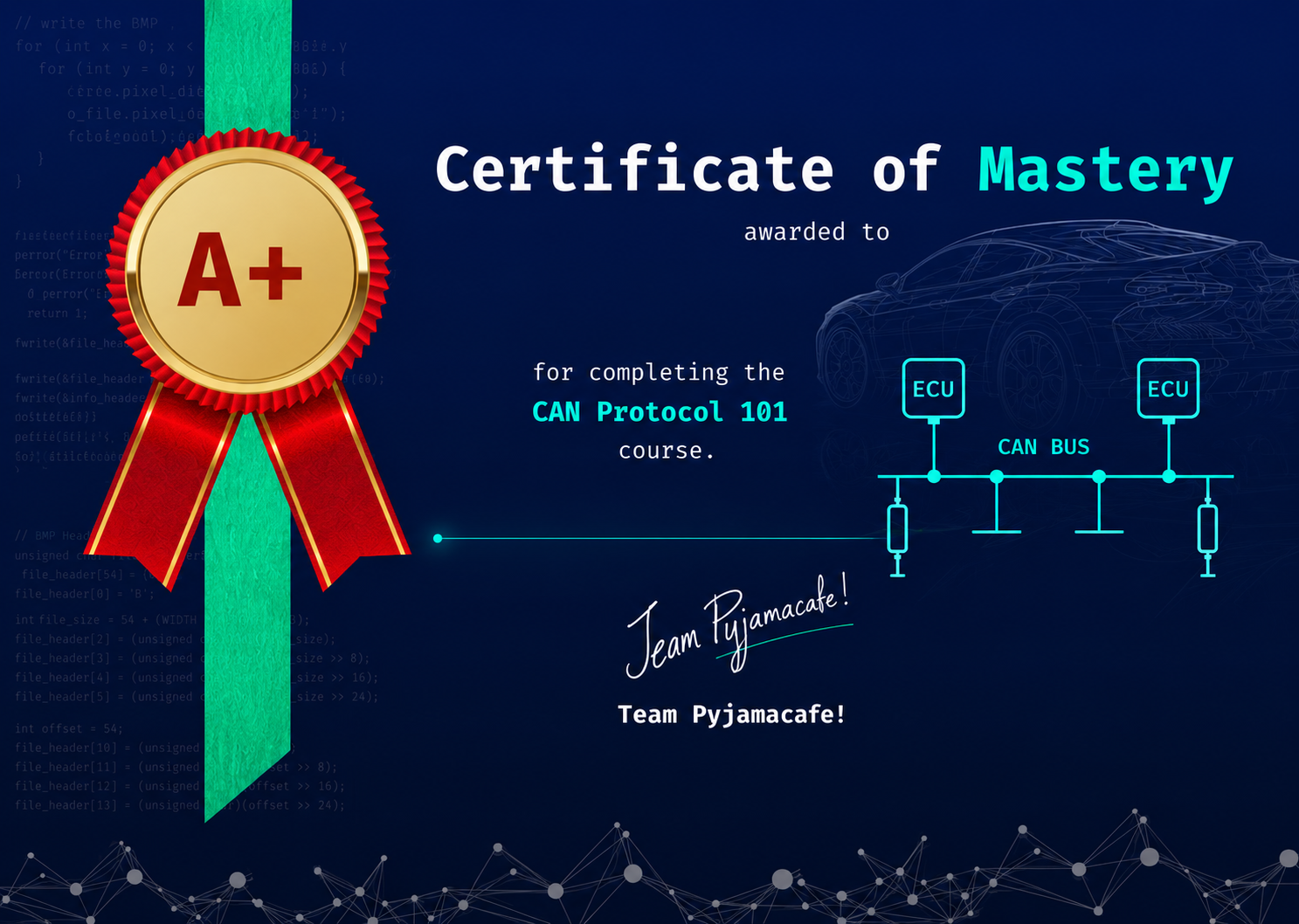
Earn a certificate for every technical track by completing 95% of the course work.
Instructors

Jegan is an Automotive Embedded Systems/Software trainer holding a Master's degree in Automotive Electronics, with 14+ years of experience spanning academia and industry. In academia, served as Assistant Professor teaching Automotive Control Systems, Electric Hybrid Vehicles, and Vehicle Dynamics while establishing a research laboratory for Rapid Control Prototyping and Hardware-in-the-Loop simulation. Guided a Formula Student electric race car project competing at international events in Italy and India.
In industry, progressed through senior roles designing competency frameworks for automotive business units, leading Model-Based Development tools creation, and managing technical delivery across diverse client segments. Currently leading the Embedded and Automotive track within a global talent development function, shaping the next generation of automotive software professionals.
Research interests focus on control strategy development for autonomous vehicles, vehicle dynamics and control, modern automotive software architectures, and vehicle software development. Continues serving on academic boards for automotive electronics programs, bridging industry innovation with academic excellence.
Audience
Embedded and Automotive Engineers: Developers working on ECUs, drivers, or communication stacks who need a solid grounding in CAN protocol fundamentals.
AUTOSAR and BSW Developers: Engineers configuring CAN Driver, CAN IF, or COM stack modules who want a stronger protocol-level foundation.
Students and Engineers New to Automotive Networking: Anyone starting out with in-vehicle networks and wanting a clear, structured introduction to CAN.
Students from Electrical, Electronics and Computer Science Engineering disciplines
Requirements
Basic understanding of digital electronics and embedded systems concepts
FAQs
Why is this course not included in the Library Access?
This course is created and delivered by a partner who is not a core member of the Pyjama Cafe team. We need to compensate the partner based on the sales of their content.
Is this recommended for beginners?
Yes! The courses are taught as if the learner has no idea about the subject.
Do I need a special machine configuration to take this course?
No!
Can I change my email-id post purchase?
As much as we’d like to support that, your account will be linked to your email-id post purchase.
What name will be printed on the Certificate?
The name you use on the platform will be printed as is on the Certificate when it is generated.
Bestseller
Beginner