
Automotive Embedded Stack
From Vehicle Electronics to AUTOSAR and Middleware Mastery.
A structured, Learning path through the Automotive Embedded software stack — from vehicle electronics and middleware concepts, through CAN and Classic AUTOSAR architecture, to Basic Software integration and the C++ internals that power production middleware.
We have organized the content to go from system-level breadth to implementation-level depth, so you build the mental models first and the hands-on configuration and coding skills next.
Bestseller
Beginner
Intermediate
Advance
Last Updated: 20 August 2026|
English|
365 Days Access.
Hey there 👋
Learning Tracks
Automotive Middleware 101
Understanding the modern vehicle electronics
This course introduces the role of middleware in modern automotive embedded systems, covering architectures, real-world examples, and controller vs pr…

Automotive Electronics
Understanding the modern vehicle electronics
This course provides a structured, end-to-end understanding of modern vehicle electronics — from foundational E/E architecture and sensors to advanced…
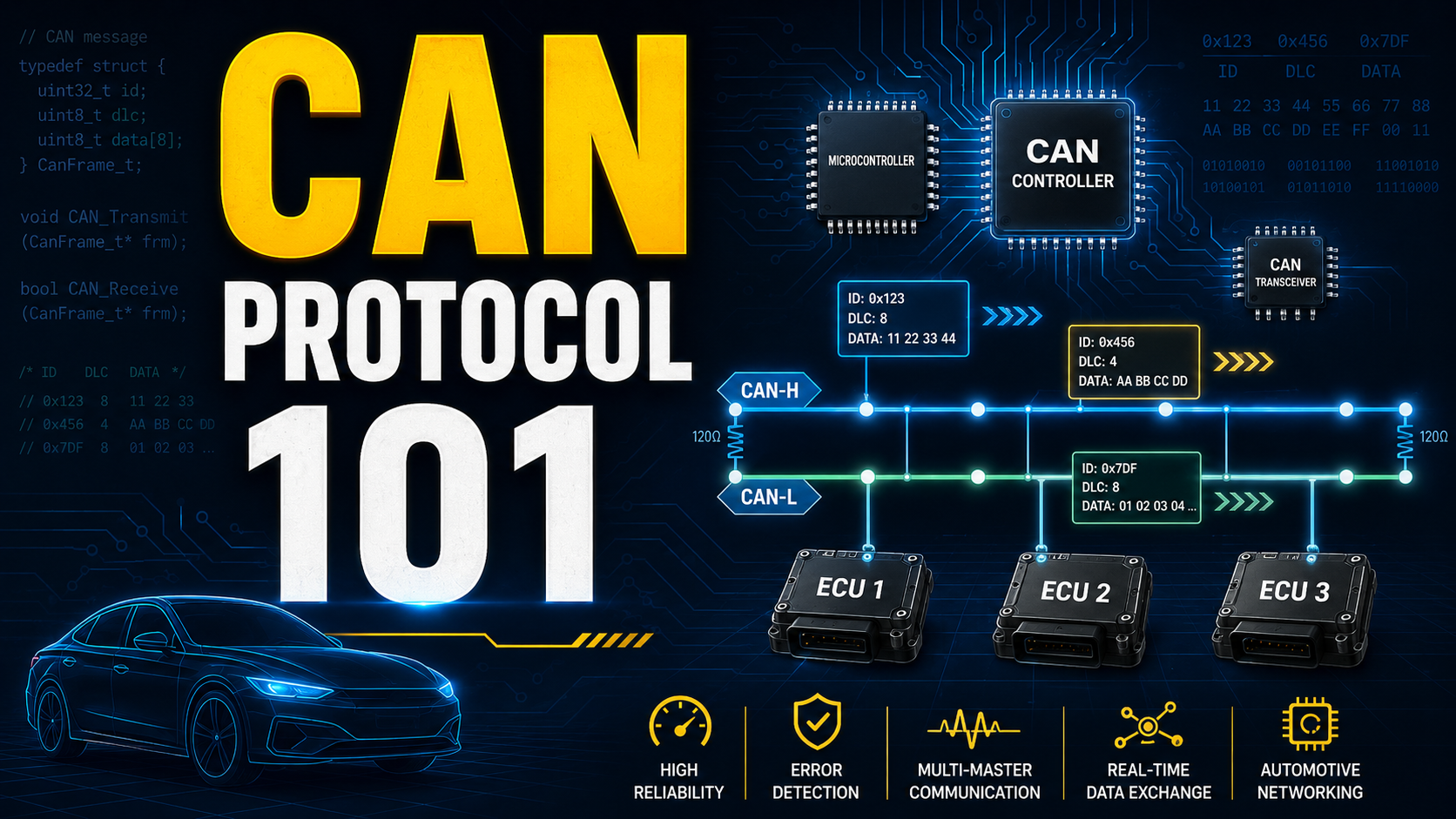
CAN Protocol 101.
Foundations of the Controller Area Network Protocol
This course builds a ground-up understanding of the CAN protocol — from network topology and bit timing to framing, arbitration, error handling, and C…
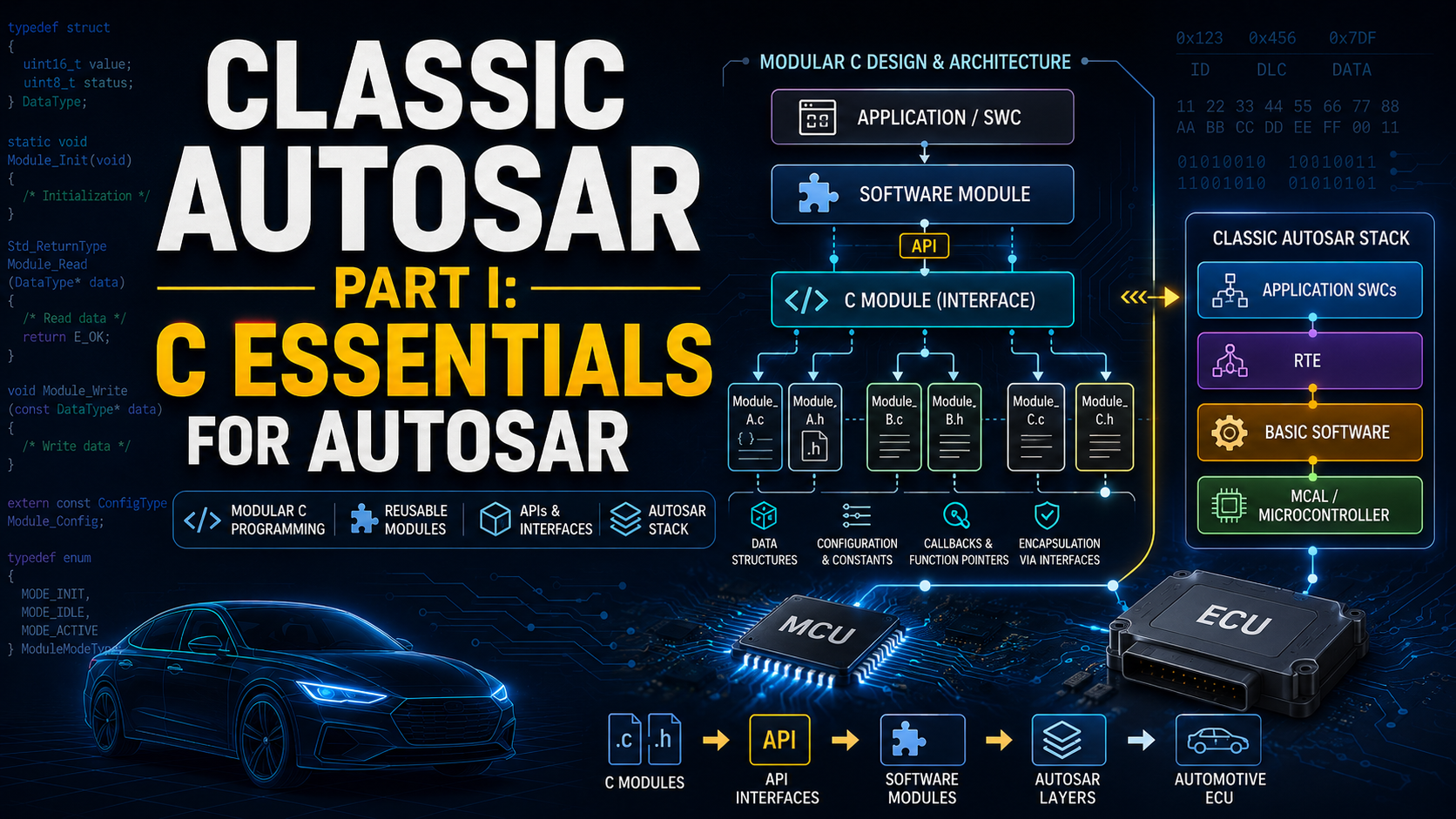
Classic AUTOSAR (Part I): C Essentials
C Essentials for AUTOSAR
This course builds the C-language foundation every AUTOSAR Classic engineer needs — memory model, linker behavior, startup sequence, pointers, type sy…
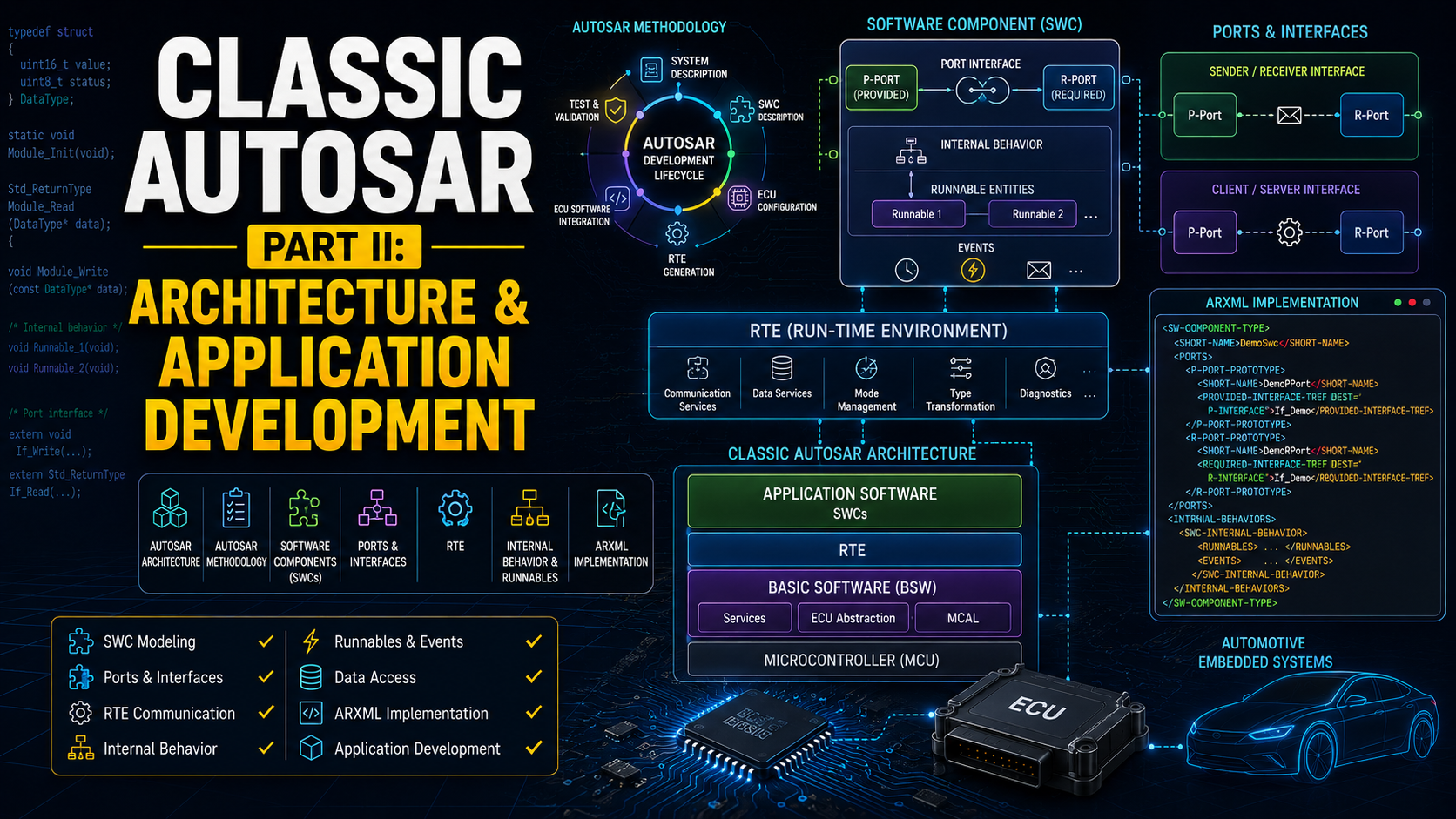
Classic AUTOSAR (Part II): Architecture and Application Development
Architecture, Methodology and MetaModels of Classic AUTOSAR.
This course builds a ground-up understanding of Classic AUTOSAR — why it exists, how the ecosystem and documentation are organized, how the developmen…
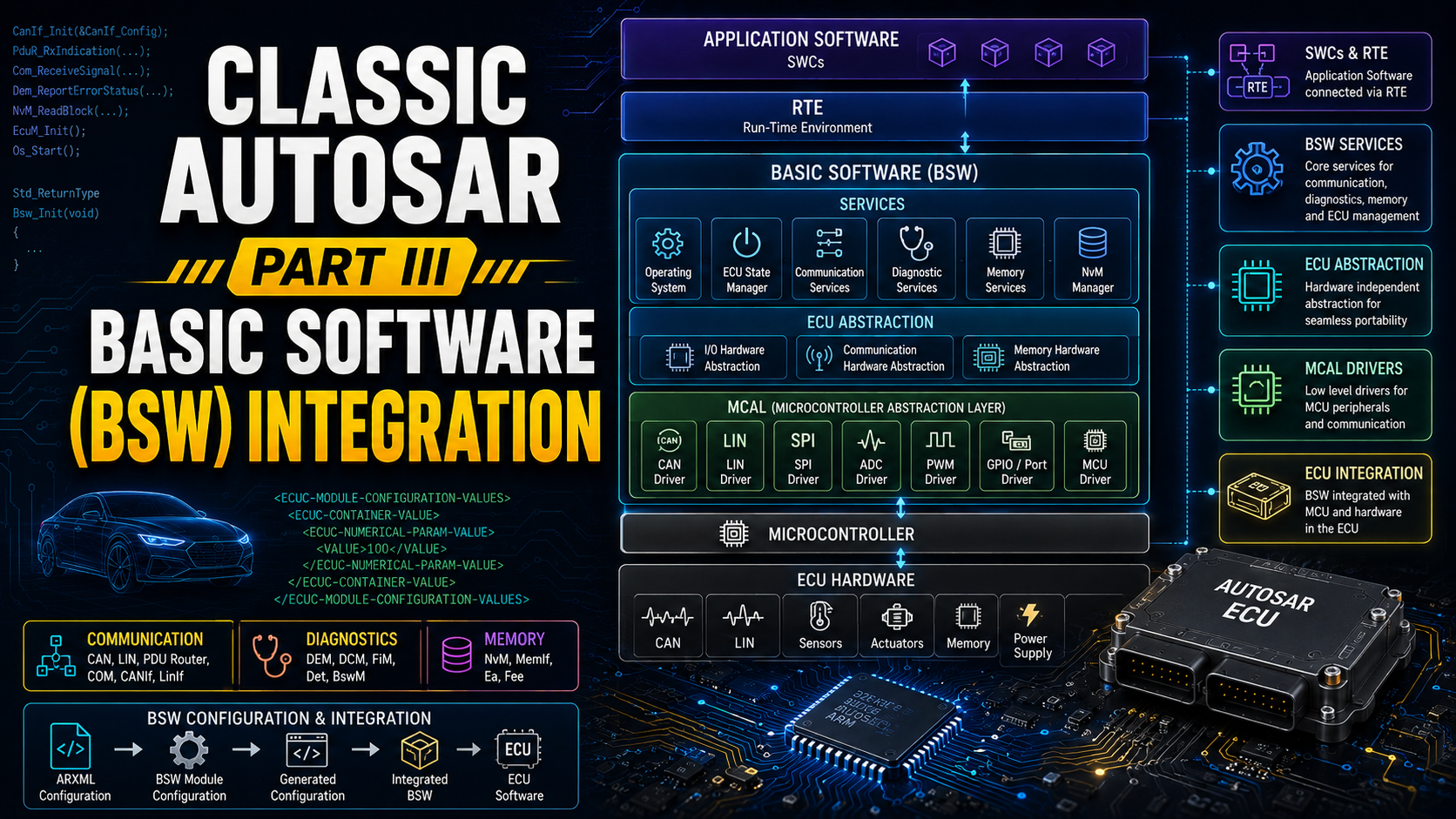
Classic AUTOSAR PART III: Basic Software (BSW) Integration.
Communication, Memory, Diagnostics, Crypto and MCAL Stacks in Classic AUTOSAR
This course takes you through the Basic Software layer of Classic AUTOSAR end to end — OS services, the communication stack, ECU state management, the…
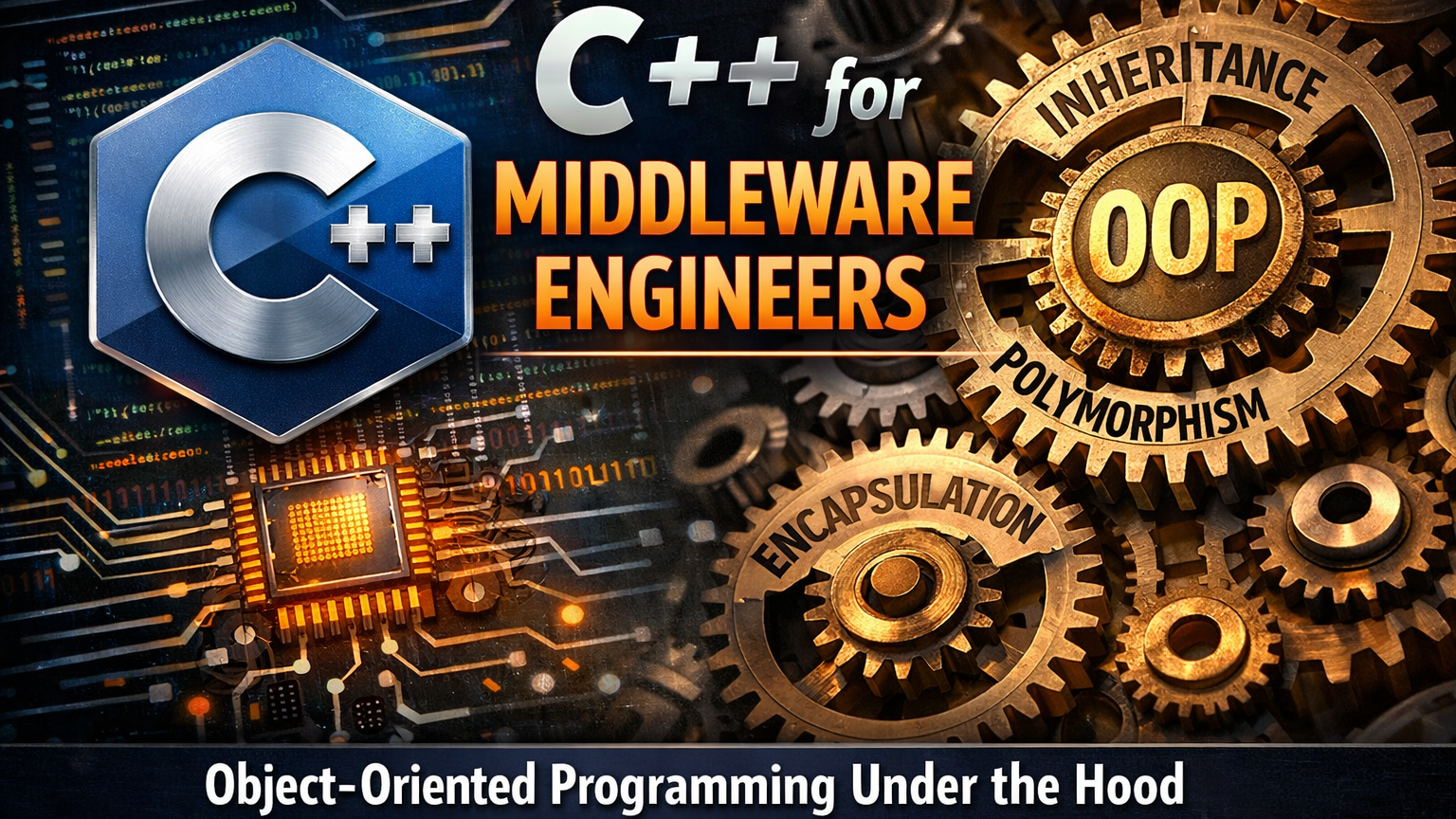
C++ for Middleware Engineers
Object Oriented Programming - Under the Hood
This course unpacks the complete compilation pipeline, memory layout, symbol resolution, object lifetime, abstraction mechanisms, and performance beha…
Automotive Middleware 101
Understanding the modern vehicle electronics
This course introduces the role of middleware in modern automotive embedded systems, covering architectures, real-world examples, and controller vs pr…
Automotive Electronics
Understanding the modern vehicle electronics
This course provides a structured, end-to-end understanding of modern vehicle electronics — from foundational E/E architecture and sensors to advanced…
CAN Protocol 101.
Foundations of the Controller Area Network Protocol
This course builds a ground-up understanding of the CAN protocol — from network topology and bit timing to framing, arbitration, error handling, and C…
Classic AUTOSAR (Part I): C Essentials
C Essentials for AUTOSAR
This course builds the C-language foundation every AUTOSAR Classic engineer needs — memory model, linker behavior, startup sequence, pointers, type sy…
Classic AUTOSAR (Part II): Architecture and Application Development
Architecture, Methodology and MetaModels of Classic AUTOSAR.
This course builds a ground-up understanding of Classic AUTOSAR — why it exists, how the ecosystem and documentation are organized, how the developmen…
Classic AUTOSAR PART III: Basic Software (BSW) Integration.
Communication, Memory, Diagnostics, Crypto and MCAL Stacks in Classic AUTOSAR
This course takes you through the Basic Software layer of Classic AUTOSAR end to end — OS services, the communication stack, ECU state management, the…
C++ for Middleware Engineers
Object Oriented Programming - Under the Hood
This course unpacks the complete compilation pipeline, memory layout, symbol resolution, object lifetime, abstraction mechanisms, and performance beha…
Hardware used
Experiments are performed on one of the following Hardware (or the Emulator option available on QEMU). The hardware is not included and needs to be bought separately.
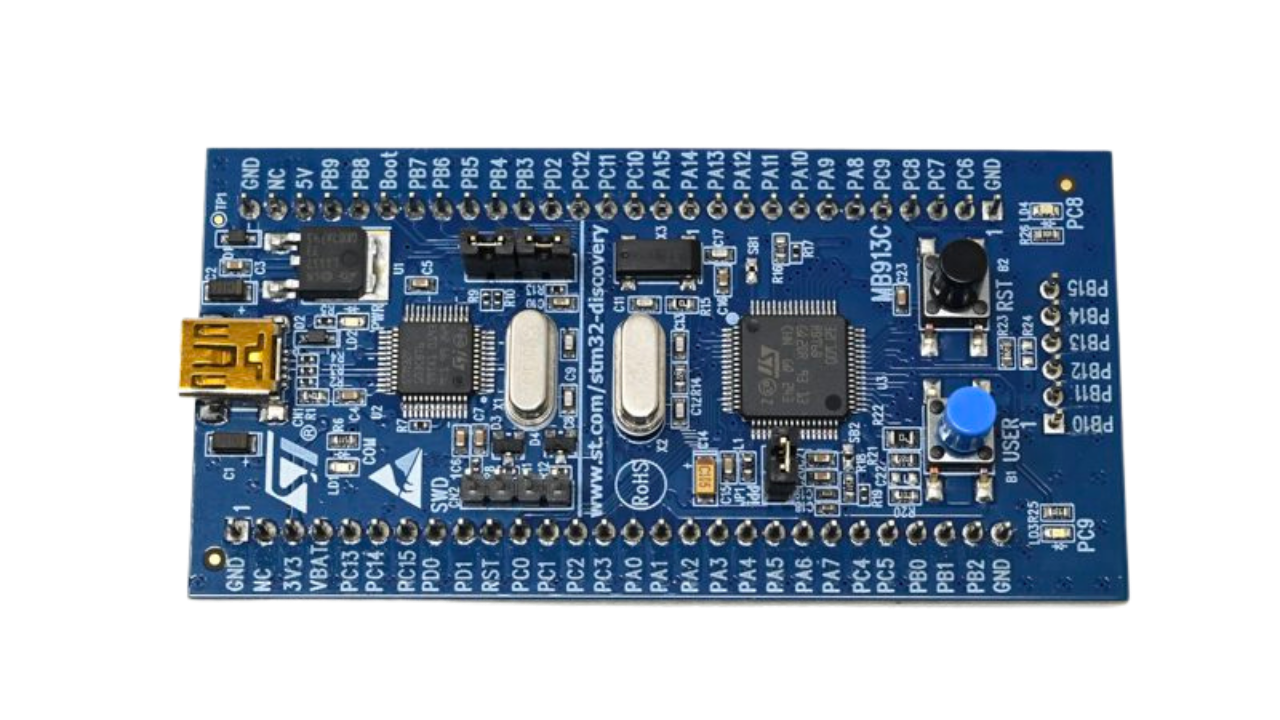
STM32VLDiscovery
This board has an ARM Cortex-M3 Core. It has a QEMU based target which makes it great for emulation as well as a good physical target to learn AUTOSAR/bare-metal firmware development on.

QEMU Emulator
A free, open-source machine emulator that lets you run and debug the AUTOSAR and embedded C/C++ course exercises entirely in software — no physical hardware required for the emulator-based experiments.
Includes
Collection of 7 Courses.
~100+ hours of recorded lectures.
340+ Lessons.
10+ downloadable resource.
Notes/Cheat-sheet.
Case studies based on open-source code.
Exercises and Coding Challenges.
Several Project implementation.
Free updates to the course.
Certificate on completion.
What you will learn
Understand the role of middleware in automotive embedded systems and how it differs from driver-level code.
Understand vehicle E/E architecture, sensors, actuators, and powertrain systems at a system level.
Master the CAN protocol - bit timing, framing, arbitration, error detection, and CAN FD.
Understand the C memory model, startup sequence, and linker behavior as used in AUTOSAR Classic software.
Apply AUTOSAR-specific C patterns - typedefs, storage classes, dispatch tables, and MemMap sections.
Understand reentrancy, ISR handling, and MISRA-aligned defensive programming for AUTOSAR C code.
Understand why AUTOSAR exists, its layered architecture, and its development methodology.
Navigate the AUTOSAR metamodel, ARXML, and configuration workflows using real tooling.
Understand VFB, ports, interfaces, SWC types, and connector patterns.
Configure runnable entities, IRVs, Exclusive Areas, and Per-Instance Memory (PIM), and generate RTE.
Understand the AUTOSAR OS, communication stack, and ECU state management (EcuM/BswM).
Configure the AUTOSAR memory stack (NVM/MemIF/FEE/EA) end to end.
Understand UDS-based diagnostics, DCM, and DEM architecture and configuration.
Understand the AUTOSAR Crypto Stack, SecOC, and secure communication concepts.
Get an overview of MCAL drivers and how they connect to the rest of the BSW stack.
Understand the complete C++ compilation pipeline, memory layout, and symbol resolution.
Inspect binaries using professional tools like nm, objdump, and readelf.
Master object lifetime, RAII, move semantics, and RVO for efficient middleware code.
Master virtual functions, vtables, templates, and function-pointer-based abstractions in C++.
Translate high-level C++ constructs into assembly-level mental models for performance-critical automotive software.
Table of Content
#1: Automotive Middleware 101
This course introduces the role of middleware in modern automotive embedded systems, covering architectures, real-world examples, and controller vs processor-based designs. Learn driver vs middleware code level differences, Covering the middleware example with a SOME/IP case study, OS essentials required for middleware development, why C++ dominates middleware development, and a clear learning roadmap for aspiring embedded middleware engineers.
Bestseller
Beginner
Intermediate
Middleware -Overview
Introduction to Embedded Middleware
Various Embedded Middleware Examples
Classification of Embedded Middleware
Middleware -Architecture
Architecture of Embedded Middleware
Driver Vs Middleware - An Example
Middleware -Use cases in Automotive
Real world Embedded Middleware examples
SOME/IP -Case study
Learning Path for Automotive Middleware Developer
Why C++ is preferred for Middleware Development?
OS 'know how' for Midddleware development
Learning Roadmap for Embedded Middleware Developers
#2: Automotive Electronics
This course provides a structured, end-to-end understanding of modern vehicle electronics — from foundational E/E architecture and sensors to advanced vehicle diagnostics, software stacks, and the latest automotive trends. The curriculum blends theory, systems engineering, and hands-on demos to provide a broader perspective on roles in automotive embedded systems, diagnostics, and E/E system development.
This program is ideal for engineering students, automotive professionals, and embedded system developers who want to explore the automotive system and software development ecosystem. It helps participants understand the industry-ready skills required for the next generation of vehicles — including EVs, ADAS, and SDVs.
Bestseller
Beginner
Intermediate
Introduction
Course Introduction
Vehicle E/E Architecture
Introduction to E/E Architecture
Components of E/E Architecture
Summary of Vehicle E/E Architecture
Automotive SDLC
V-Model for System Development
Development of Engine Control System
Validation phases of Engine Control System
Introduction to ASPICE
Summary of Automotive SDLC
Automotive STLC
Software Testing Life Cycle
HIL Validation
Summary of Automotive STLC
Automotive Sensors
Introduction to Automotive Sensors
Position Sensing Methods
Pressure, Temperature Sensing Methods
Acceleration Sensing
Exhaust Gas Oxygen Measurement
Knock and MAF Sensor Working
Sensors In Driver Assistance Systems
Virtual Sensors and Estimators
Summary of Automotive Sensors
Scilab Installation
Demo-Sensor Fusion with Complementary Filter
Demo-Sensor Modelling with XCOS
Automotive Actuators
Solenoid and Fuel Injectors
EGR Valve and Ignition System
Relays and Reed Switch
BLDC, Servo and Stepper Mechanism
Chemical Actuators for Airbag
Summary of Automotive Actuators
Demo-Servo Actuator Modelling with XCOS
Powertrain Systems
Fundamentals of Engine Working
Engine Closed-Loop Control Functions
Electronic Fuel Injection system
Engine Performance Parameters
Engine Maps and Control modes
Hybrid Powertrain Configurations
Hybrid powertrain Control Strategy
Summary of Powertrain Systems
Vehicle Motion Control System
Introduction to Vehicle Axes
ABS Working Principle
TCS Working Principle
ESP Working Principle
Vertical Vehicle Dynamics – Suspension System
ACC – Longitudinal Vehicle Control
Active Vs Passive Safety System
Summary of Vehicle Motion Control System
Vehicle Diagnostics
Introduction to Vehicle Diagnostics
Diagnostic Requirements for Automotive Systems
OBD Jargons
OBD Milestones and Standardization
Fundamental Concepts and Terms in UDS
UDS Communication: Service Types, Primitives, and Message Types
UDS Addressing Types
UDS Message Structure
UDS Sessions and Services
UDS Request and Response
Role of Diagnostics in Different ECU Development Phases
Summary of Vehicle Diagnostics
Vehicle Software Architecture
Exploring Various Vehicle Software Stacks
Roles of Classic AUTOSAR Layers
Internals of the Classic AUTOSAR Stack
Adaptive AUTOSAR Architecture
Role of Various Functional Clusters in Adaptive AUTOSAR
Role of Vehicle Software Platform Suppliers
Linux-Based Software Stacks for Automotive Systems
Summary of Vehicle Software Architecture
Current and Emerging Trends in Automotive Technology
Introduction to Latest Trends in Automotive Ecosystem

Electric Vehicle Components
AI Application in Electric Vehicle

Autonomous Driving Software Pipeline
Perception, Localization and Prediction Module
Motion Planning Module
Motion Control Module
Understanding Software Defined Vehicle and Its Architectural Framework
Summary of Current Trends in Automotive Technology
Demo- Electric Scooter Modelling
Demo- RRT* Based Local Path Planner
Career opportunities in Automotive Embedded Systems
Automotive System Development Flow
Revisiting V-Development Cycle
Career Roles in Automotive Embedded System
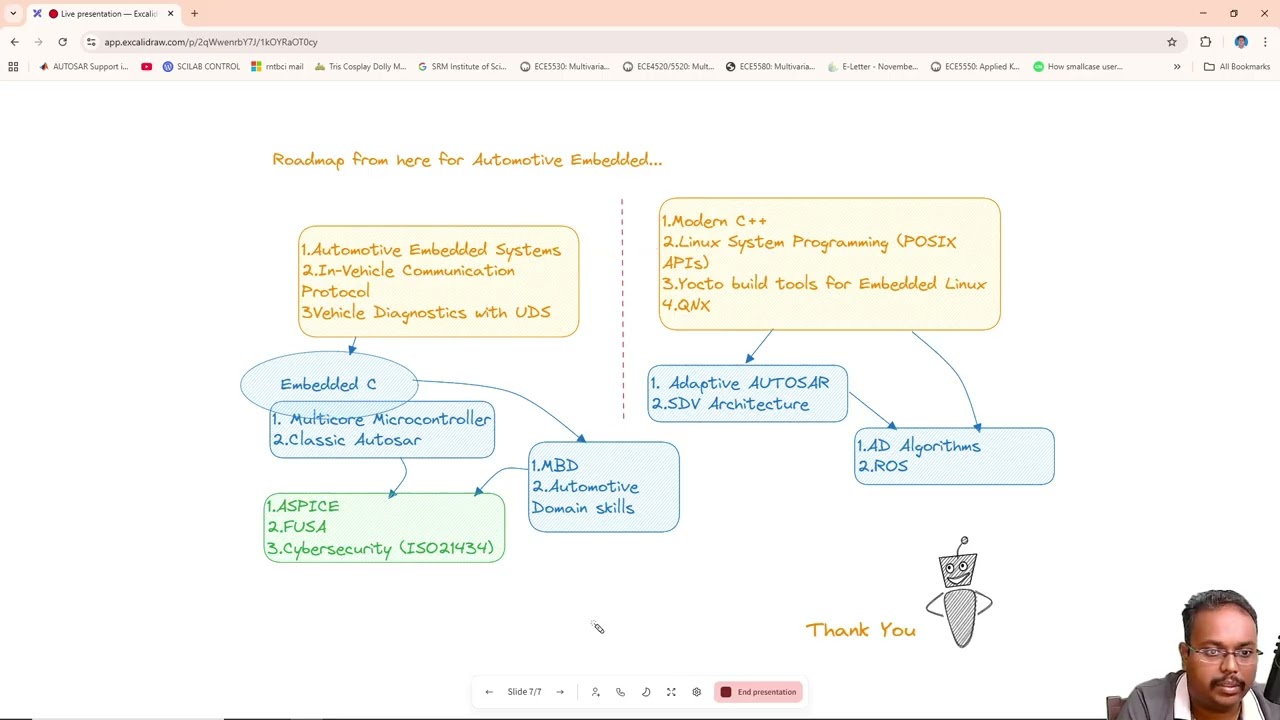
RoadMap for Automotive Embedded System
Demo Codes
Demo Scilab Codes and XCOS Models
#3: CAN Protocol 101.
This course builds a ground-up understanding of the CAN protocol — from network topology and bit timing to framing, arbitration, error handling, and CAN FD — the foundation every automotive and embedded communications engineer needs.
By connecting bus-level electrical behavior with frame structure, error detection, and protocol state machines, this course prepares you to read CAN traces, debug bus issues, and reason confidently about CAN-based systems.
Bestseller
Beginner
Module 1: CAN Communication
Network, Node, Controller, Transceiver, Bus
CAN Bus Levels & Logic
Communication Principle
Module 2: Bit Timing & Synchronization
Bit Segments, Time Quanta & Baud Rate
Hard Sync at SOF & Resync (SJW)
Module 3: CAN Framing
Frame Types & Data Frame (Standard / Extended)
Addressing & Acceptance Filters
Bit Stuffing
Remote Frame
Error Frame
Overload Frame
Acknowledgement (Positive / Negative)
Module 4: CAN Bus Access
Bitwise Arbitration
Module 5: CAN Error Detection
Bit Error (Including CSMA/CD)
Stuff Error
CRC Error
Form Error
ACK Error
Module 6: CAN Data Protection
NRZ Coding & Twisted Pair
Bus Termination
Error Handling, Tracking & State Machine (Including the Babbling Idiot Scenario)
Module 7: CAN FD
Why CAN FD Exists
Bit Rate Switch (BRS)
64-Byte Payload & DLC Encoding
CRC-17/21 & Error State Indicator
#4: Classic AUTOSAR (Part I): C Essentials
This course builds the C-language foundation every AUTOSAR Classic engineer needs — memory model, linker behavior, startup sequence, pointers, type systems, and preprocessor patterns — all grounded in real AUTOSAR conventions and code you'll actually encounter in production stacks.
By connecting core C fundamentals with AUTOSAR-specific practices like MemMap sections, reentrancy, ISR handling, and MISRA-aligned defensive programming, this course prepares you to read, debug, and write AUTOSAR-compliant C code with confidence.
Bestseller
Beginner
Intermediate
Part I: C Language Foundations
Introduction to Course
Cautionary Note - Why this Course Exists?
C Memory Model
Tools Setup and Project Folder Structure
Booting Sequence and Role of Startup File
Memory Segment Analysis
Linker Control
Stack Memory Analysis
Pointer Intro
Pointer Arithmetic and Array of Pointers Usage
AUTOSAR Pointers
AUTOSAR Type System
typedef for Abstraction
AUTOSAR Types
Storage Classes Uses in AUTOSAR
Type Qualifiers
C Type Qualifiers
Preprocessor Basics
#ifdef, #ifndef, #if-else
Conditional Compilation
Preprocessor
AUTOSAR Version Schemes
Struct Usage for AUTOSAR Config
Memory Alignment and Struct Padding
Need for Padding Control in AUTOSAR
Use of Bitfields
Unions Usage
Iterating Over Array of Structures
Struct Memory Alignment, Padding, Bitfields
Function Usage
Part II: Advanced C Patterns
Translation Unit in Compilation
Linkage Basics
Header File Practices
Circular Dependency and AUTOSAR Module Arrangement
External/Internal Linkage
Function Pointer Basics
Function Pointers
Passing Function as Argument - Strategy, Factory Pattern
Dispatch Table and Jump Table
FnPtr Structure and Virtual Tables
Multiple Callbacks for Same Event
Observer Patterns - Callback Arrays
Single Indirection Recap
Multi Indirection with Examples
Const Double Pointer
Null Handling and Reordering Pattern
Multilevel Indirection
Part III: AUTOSAR-Specific Patterns
AUTOSAR MemMap Mechanism
Code, Var, Const and Config Sections
Compiler Specific Pragmas and Attributes
Multicore Scenarios
AUTOSAR MemMap
Reentrant Functions Properties
Non-Reentrant Vs Reentrant Functions
Concept of Critical Section
Detecting Non-Reentrant Patterns
Reentrancy Guard
Interrupt Service Routine Basics
ISR Categories in AUTOSAR
ISR Vs Normal Function
Exit Interrupt and Early Return from ISR
Critical Section
MMIO Basics
Use of 'volatile' for Accessing HW Register
Typecasting for MMIO
Bitwise Operations for HW Registers
Signal Packing and Unpacking for Protocol Data
AUTOSAR Signal Protection Mechanism
GPIO Endianness Demo
Defensive Programming - Null Ptr Validation
Defensive Programming - Array Bound Violation
Defensive Programming - Problem with Ignoring Return Value
MISRA C / Defensive Programming
#5: Classic AUTOSAR (Part II): Architecture and Application Development
This course builds a ground-up understanding of Classic AUTOSAR — why it exists, how the ecosystem and documentation are organized, how the development methodology actually works, and how the metamodel and ARXML underpin every tool and workflow you'll use.
By walking through layered architecture, VFB, ports and interfaces, SWC types, and runnable/RTE internals with demos and case studies, this course prepares you to read, configure, and reason about AUTOSAR-based software with confidence.
Bestseller
Beginner
Intermediate
Birth and Objectives of AUTOSAR: Understanding Why AUTOSAR Exists and What Problems It Solves
Introduction to the Course
SW Evolution in Automotive
AUTOSAR - Successor of OSEK/VDX
Legacy Development Problems
AUTOSAR Solution for Legacy Challenges
OSEK OS Features
OSEK Vs Classic AUTOSAR - Inheritance Map
AR Consortium Roles
AUTOSAR Layered Architecture
BSW Structure - Function at High Level
CAN Dataflow - Example
AR Layers Stripped - Animation Video
Expected Outcomes from Classic AR
Overview of AUTOSAR Org: Navigating the AUTOSAR Ecosystem and Understanding Document Organization
AR Documentation
Practical Workflow of NVM
AR Data Exchange Format
AUTOSAR Methodology: Understanding How AUTOSAR-Based Development Actually Works
AR Development Flow Based on Methodology
AR Configuration Classes
RTE Generation
Top-Down, Bottom-Up and Round-Trip Workflows
AR Tool Chain Landscape
Authoring Tools Vs BSW Tools
Static and Generated Code
Real World Application Integration & Summary
AUTOSAR MetaModels: Understanding the Foundation That Makes Everything Work
Demo: Environment Setup & autosarfactory Intro
Demo: Autosar Factory - Usage
AR Application Datatypes - Categories
AR Application Datatypes - Configurations
Implementation Datatype / Base Types / Data Prototypes
Demo: Data Type Modelling
AR MetaModel - Fundamentals
ARXML Design Principles - Model Hierarchy
AR Metamodel Documentation
Building Blocks of AUTOSAR SWC: The Fundamental Elements of Application Architecture
Introduction to VFB
Ports & Component Prototype
Interface Type (SR, CS, Param, NV, MS, Trigger)
Complete Integration Example
AR Interfaces Example I (SR)
AR Interfaces Example II (CS)
AR Interfaces Example III (MS)
AR Interfaces Example III (Other Interfaces, Best Practices)
Demo: Interface Design
SWC Types I
SWC Types II (CDD and Others)
Demo: SWC Types & Port Modelling
Connector Types / Best Practices
Demo: Assembly & Delegation Connectors
Software Component Internals: From Architecture to Behavior and Code
AR Runnable Entities - Internal Behaviour
AR Runnables C Implementation
IRV, Exclusive Area and PIM
Speed Controller - Case Study
Relationship Between Runnable/Events - All Possible RTE Events
DRE / Error Event / OIE
Init Event / Mode Switch Event / Internal Trigger Event / BG Event
Event Scheduling, Event Type Selection, Async Client Server Pattern / Event Summary
Demo: Internal Behaviour - Runnables
Demo: Inter-Runnable Variables (IRV)
Demo: Exclusive Areas
Demo: Per-Instance Memory (PIM)
RTE API for Interfacing
Defensive Error Handling Pattern
Demo: RTE Generation & C Code Skeleton
#6: Classic AUTOSAR PART III: Basic Software (BSW) Integration.
This course takes you through the Basic Software layer of Classic AUTOSAR end to end — OS services, the communication stack, ECU state management, the memory stack, diagnostics, the crypto stack with SecOC, and MCAL — connecting architecture to real ARXML configuration at every stage.
By working through module interactions, configuration workflows, and real-world data flows across BSW, this course prepares you to integrate, configure, and debug AUTOSAR Basic Software with confidence.
Bestseller
Intermediate
Advanced
AUTOSAR OS and BSW Architecture
AR Architecture - ICC, Configuration Classes
BSW Module Classification, BSW Interaction Rules
AR OS - Alarm / Schedule Tables
AR OS - Event Mechanism, Timing, Memory Protection, Multicore OS Features
Communication Stack
AR ComStack Architecture, PDU Terminology, CAN Frame Walkthrough
CAN Driver, CAN IF and CAN TP Overview
CAN TP in Detail (ISO 15765-2)
PDU Routing Path, COM Module, COM Stack - ARXML Config
Signal Packing and Endianness
COM Transfer Properties, Update Bits and COM Filtering
IPDU Groups / IPDUM / Signal Gateway
COMM and NM Basics
LIN/Ethernet Stack Architecture
ECU State Management
EcuM, BswM and EcuM State Machine - Overview
EcuM Startup/Shutdown Sequence - Wakeup Source, Sleep Modes
BswM Complete, BswM Vs EcuM Mode Management Config - Summary
Memory Stack
MemStack Architecture - EEPROM Path
NVM Block Types / Basic Storage Object / NVM API
NVM Job Processing / Callback / ARXML Configuration
MemIF / FEE / EA / Memory Drivers
Full Memory Stack RW Flow / ARXML Config
Diagnostics (UDS, DCM, DEM)
Diagnostics Architecture - UDS over CAN, ISO 14229 Services
Session Management, Security Access and Other Diag Services
DCM Internal Architecture, DCM Buffer Handling, DCM Multireq Protocol, DCM Timing Params
Configure DCM
DEM Architecture, Core Functionality, DTC Examples
Event Debouncing, Event Reporting, Event Memory, Aging, Freeze Frame and Extended Data Records
DEM Interfaces, OBD in DEM, FIM
UDS Flash Programming, ARXML Config and Workflow
Crypto Stack and SecOC
Cryptostack Architecture, Automotive Use Cases, CSM Lifecycle
AES Explained, Hash Function, MAC Generation and Verification
RSA (Asymmetric) Key Management
CryIF Config, Crypto Driver Config / SecOC Intro (Optional)
Why SecOC, SecOC Architecture
SecOC - TX, RX
FVM (Freshness Value Manager) Strategy
Secure IPDU Layout, SecOC COM Integration, ARXML Config
MCAL and Wrap-Up
MCAL Overview - Drivers, Standards, Architecture, Port/DIO Driver
ADC Driver - Other MCAL Modules
Summary and Road Map
#7: C++ for Middleware Engineers
This course unpacks the complete compilation pipeline, memory layout, symbol resolution, object lifetime, abstraction mechanisms, and performance behavior. You will analyze real binaries, inspect assembly output, and use professional tools like nm, objdump, and profilers to understand how design choices affect execution.
By connecting theory with system-level realities, this course builds strong mental models that help you write efficient, maintainable, and production-grade C++ code—especially for embedded systems, middleware, and performance-critical software.
Bestseller
Beginner
Intermediate
Birth of an Executable : Under-the-Hood
Introduction to the Course
Example Codes - Used in this Course
Evolution of C++
Toolchain Installation
C++ Compilation Pipeline
Preprocessing Stage
Compilation Stage
Assembler and Linker Role
GCC Utilities - 'nm' and 'size'
Stack and Heap Monitoring Tools
'objdump' utility

Significance of LMA and VMA
'weak' attributes in Linking
Compile Time Vs Link Time Decisions
Caveats in Linker
Useful Tools- To Learn C++ Under the hood
Tools for Performance Analysis
Compiler optimization Flags and its Effects
Loop unrolling, Vectorization and 'volatile' usage
C++ - Values, References, and Efficiency :Under-the-Hood
'const' Type Qualifier
'constexpr' usage
'C' Style Array and Pointer Arithmetic Basics
Dynamic Arrays and Memory Management Challenges
C-String Vs std::string in C++
Range Based For Loop in C++
L-Values and R-Values at Assembly Level
Reference in C++
References Under-the-Hood - As a 'Hidden' pointer
LValue,RValue References Usecases and Performance Benchmarking
Internals of 'inline' function
Abstraction, Object Lifetime and Ownership : Under-the-Hood
Function Pointers -Callback functions and Dispatch Table in Middleware
Abstraction in C using Struct with function pointers Vs C++ Class
Access Specifiers in C++ Class
'static' Data Member and Member Function in the class
'static' objects and Middleware Use-case
Constructor and Destructor in C++ Class
Copy Constructor for Object Owning Resources
Return Value Optimization with Copy Elision
Move Constructor
Move Semantics
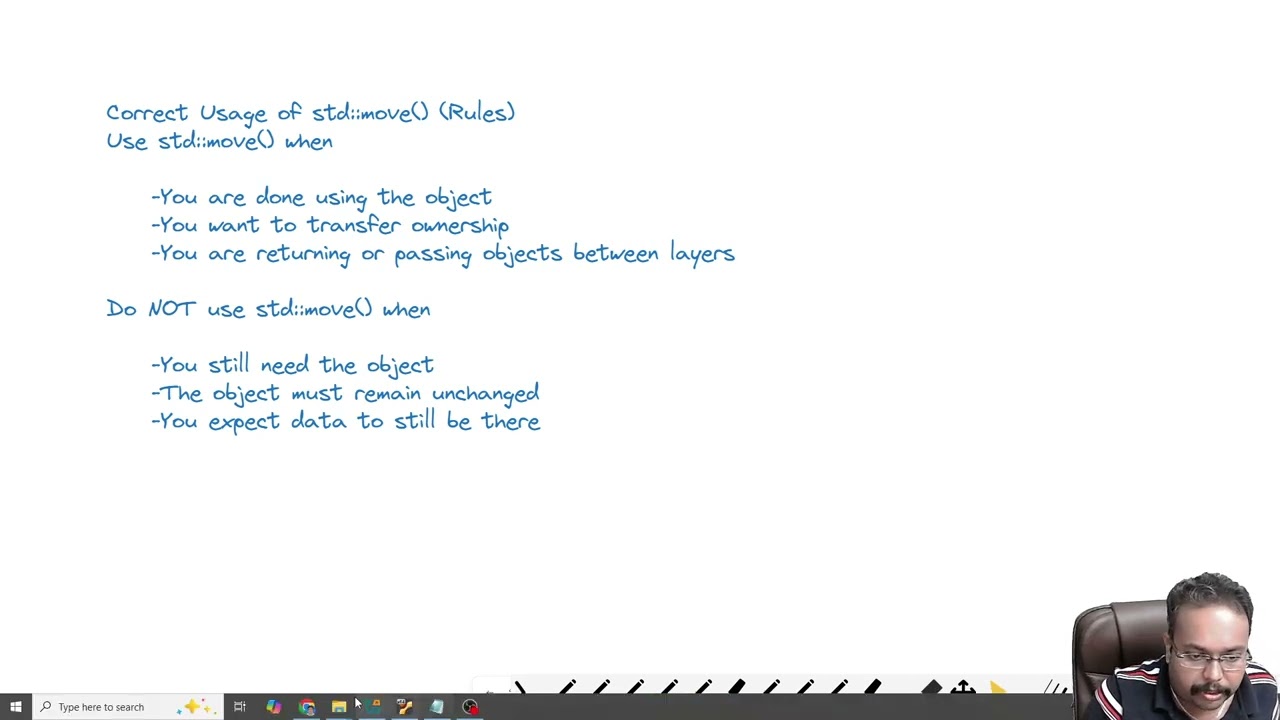
Shallow Copy Vs Deep Copy - Uses
From Overloading to Templates: Under-the-Hood
Function Overloading and 'Name Mangling' under-the-hood
Inheritance and its Types
Execution order of constructor and Destructor
Function Overriding and the middleware use-case
Function Overriding -Mental Model and Object Slicing
Virtual functions and Runtime Binding - Under the hood
Significance of 'final' keyword
why virtual constructor don't exist? but virtual destructor does?
Operator Overloading - Basics and Middleware use cases
Operator Overloading - Under the hood
Ownership Transfer with Move assignment operator
Function Object or Functor - Overloading Function call () operator
Lambda Function in C++ and its Internals
Namespaces and its uses in Middleware
Templates in C++
Road Map From Here...
C++ Learning path for Embedded Middleware Engineers
Sample Certificate
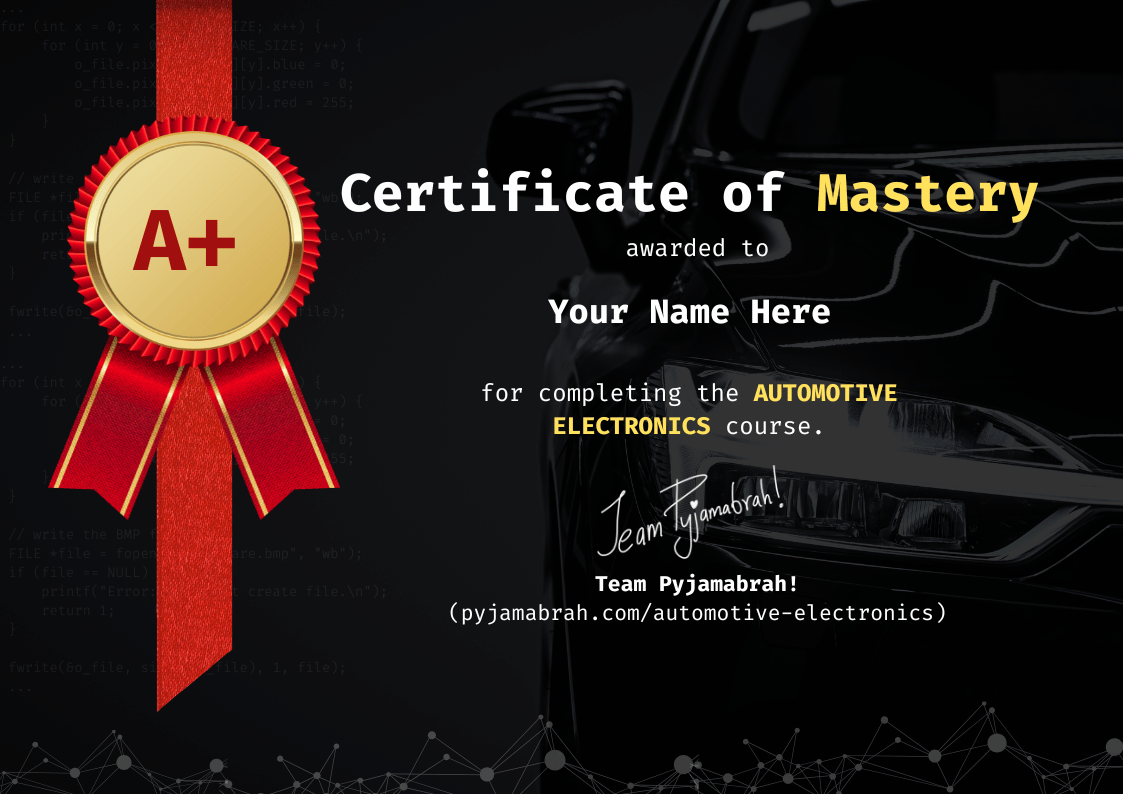
Earn a certificate for every technical track by completing 95% of the course work.
What sets this apart?
Purpose-built path for the Automotive Embedded and AUTOSAR ecosystem, not a generic embedded curriculum.
Goes from system-level vehicle electronics down to ARXML configuration and C/C++ binary internals.
Real AUTOSAR methodology, metamodel, and RTE workflows, not just theory slides.
Dedicated CAN protocol foundation before diving into the AUTOSAR communication stack.
Covers the full BSW breadth - OS, ComStack, Memory, Diagnostics, Crypto/SecOC, and MCAL.
C++ internals taught specifically through a middleware and embedded lens.
Connects every concept to real automotive and middleware use cases.
Learn at your own pace with lifetime-style access for the bundle duration.
Instructors

Jegan is an Automotive Embedded Systems/Software trainer holding a Master's degree in Automotive Electronics, with 14+ years of experience spanning academia and industry. In academia, served as Assistant Professor teaching Automotive Control Systems, Electric Hybrid Vehicles, and Vehicle Dynamics while establishing a research laboratory for Rapid Control Prototyping and Hardware-in-the-Loop simulation. Guided a Formula Student electric race car project competing at international events in Italy and India.
In industry, progressed through senior roles designing competency frameworks for automotive business units, leading Model-Based Development tools creation, and managing technical delivery across diverse client segments. Currently leading the Embedded and Automotive track within a global talent development function, shaping the next generation of automotive software professionals.
Research interests focus on control strategy development for autonomous vehicles, vehicle dynamics and control, modern automotive software architectures, and vehicle software development. Continues serving on academic boards for automotive electronics programs, bridging industry innovation with academic excellence.
Audience
Embedded and Systems Engineers moving into the automotive domain.
AUTOSAR SWC and BSW Developers who want a complete, structured path from architecture to implementation.
Middleware and Platform Developers building communication stacks and infrastructure software.
C/C++ Developers aiming for automotive and systems-level roles.
Students from Electrical, Electronics, and Computer Science Engineering disciplines.
Requirements
Basic understanding of C programming (pointers and structures).
Interest in automotive electronics and embedded software.
Some exposure to digital systems is good (but not strictly required).
FAQs
How is this bundle different from the Library Access?
This bundle combines all the partner courses in one place. The partner courses are created and delivered by industry experts who are not core members of the Pyjama Cafe team, so they are NOT included in the Library Access and are sold separately. This bundle packages all of them together.
Do I get all the partner courses with this single purchase?
Yes. The bundle grants access to all the partner courses listed on this page.
Is this recommended for beginners?
Yes! The courses are taught as if the learner has no idea about the subject.
Do I need a special machine configuration to take these courses?
No!
Can I change my email-id post purchase?
As much as we’d like to support that, your account will be linked to your email-id post purchase.
What name will be printed on the Certificate?
The name you use on the platform will be printed as is on the Certificate when it is generated.
Bestseller
Beginner
Intermediate
Advance