
Automotive - Middleware 101
Note: This is a Partner Course and NOT included in the Library Access!
This course introduces the role of middleware in modern automotive embedded systems, covering architectures, real-world examples, and controller vs processor-based designs. Learn driver vs middleware code level differences, Covering the middleware example with a SOME/IP case study, OS essentials required for middleware development, why C++ dominates middleware development, and a clear learning roadmap for aspiring embedded middleware engineers.
Bestseller Beginner Intermediate
(4.9) 100+ students enrolled.
Last updated: 3 January 2026 | English | 30 days Access.
includes
what you will master through the journey
contents and preview lectures ...
Middleware -Overview
Middleware -Architecture
Middleware -Use cases in Automotive
Learning Path for Automotive Middleware Developer
What is so special about this course?
What makes this course special is its end-to-end, system-level view of embedded middleware, going beyond definitions and APIs.
Instead of treating middleware as a black box, the course explains why it exists, where it fits, and how it is designed—from drivers to applications. It connects theory with real automotive use cases, including a practical SOME/IP case study, and highlights real-world middleware architectures used in Automotive production programs.
The course also bridges critical gaps by covering OS ‘Know How’ for middleware development and C++ design rationale, and finally provides a clear learning roadmap, enabling learners to confidently grow into industry-ready embedded middleware developers.
Certificate
The journey through the course is a challenging one! Our courses are packed with insights and will take time to sink in. You will be awarded with a Certificate of Mastery when you complete 95% of the course work.
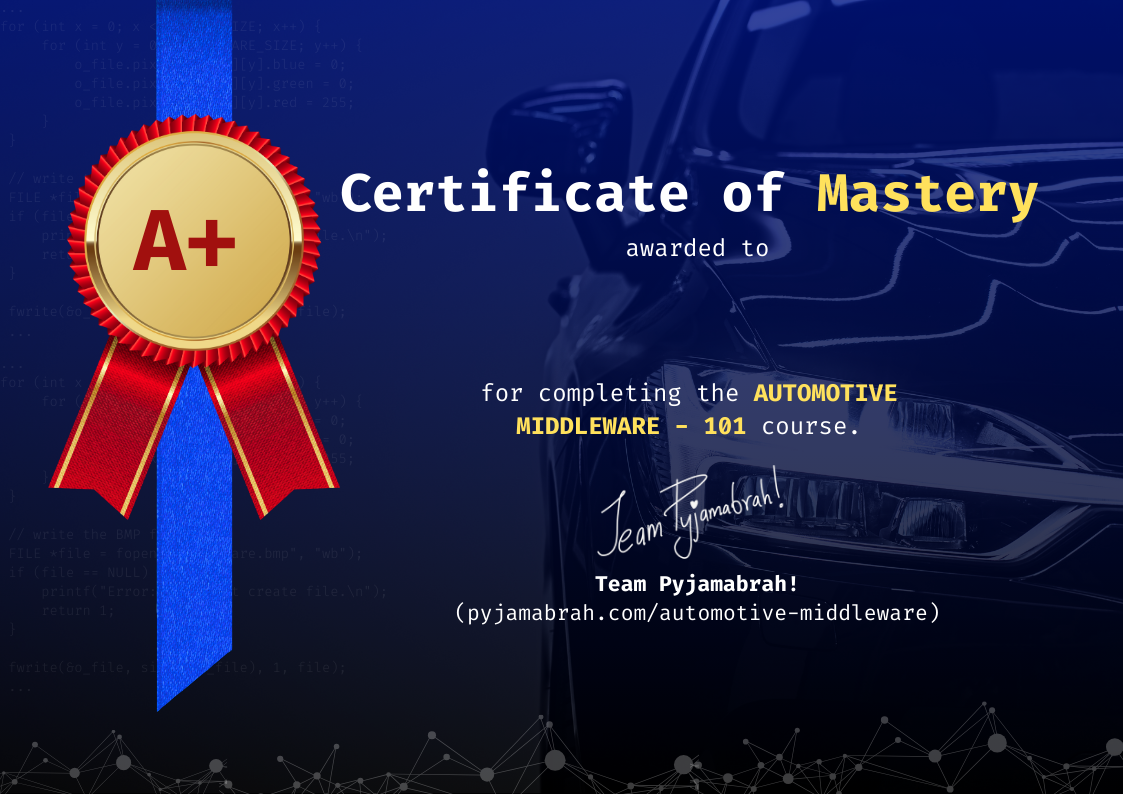
What you see above is a sample certificate. The design of this certificate will be modified from time to time to make it more shiny and reflect the rightly earned pride!
There will always be a dedicated certificate identification number to verify it with us. This should enable anyone to check the authenticity of the certificate.
How this is different from Others
| Feature | Us! | Others |
|---|---|---|
| System-Level Perspective | ||
| Driver vs Middleware Code level Comparison | ||
| Controller vs Processor Focus | ||
| Real Automotive Use Cases | ||
| SOME/IP Case Study | ||
| OS Know-How for Middleware Developers | ||
| Industry-Oriented Learning Roadmap |
Instructors

Requirements
Who this course is for
FAQs
This course is created and delivered by a partner who is not a core member of the pyjambrah team. We need to compensate the partner based on the sales of their content.
Is this recommended for beginners?
Yes! The courses are taught as if the learner has no idea about the subject.
Do I need a special machine configuration to take this course?
No!
Can I change my email-id post purchase?
As much as we'd like to support that, your account will be linked to your email-id post purchase.
What name will be printed on the Certificate?
The name you use on the platform will be printed as is on the Certificate when it is generated.
An introduction to the embedded middleware layer for Automotive Embedded Systems.
Read more...