
C++ for Middleware Engineers
Note: This is a Partner Course and NOT included in the Library Access!
This course unpacks the complete compilation pipeline, memory layout, symbol resolution, object lifetime, abstraction mechanisms, and performance behavior. You will analyze real binaries, inspect assembly output, and use professional tools like nm, objdump, and profilers to understand how design choices affect execution.
By connecting theory with system-level realities, this course builds strong mental models that help you write efficient, maintainable, and production-grade C++ code—especially for embedded systems, middleware, and performance-critical software.
Bestseller Beginner Intermediate
(4.9)
Last updated: 8 February 2026 | English | 365 days Access.
includes
what you will master through the journey
contents and preview lectures ...
Birth of an Executable : Under-the-Hood
C++ - Values, References, and Efficiency :Under-the-Hood
Abstraction, Object Lifetime and Ownership : Under-the-Hood
From Overloading to Templates: Under-the-Hood
Road Map From Here...
What Makes “OOPS Under the Hood” Special
“OOPS Under the Hood” is not a traditional C++ course that focuses only on syntax, libraries, or design patterns. Instead, it teaches how C++ actually works beneath the surface—inside the compiler, linker, memory system, and runtime environment. This deep technical focus is what makes the course truly unique.
Most developers learn how to write C++ code, but few understand what happens after pressing “compile.” This course bridges that gap by explaining how source code becomes an executable, how objects are laid out in memory, how virtual functions are dispatched, and how optimizations affect performance. Learners gain insight into what the machine really does with their code.
Another key strength of this course is its strong connection to real-world systems such as embedded platforms, middleware, and performance-critical applications. Students learn why design decisions matter when resources are limited, startup time is critical, or latency must be minimized. This makes the learning highly relevant to industry needs.
The course also emphasizes tool-based learning. Participants work with professional utilities such as nm, objdump, size, and profiling tools to analyze binaries and debug system-level issues. This practical exposure prepares learners for real production environments.
Rather than encouraging memorization, the course builds strong mental models. Students learn to reason about memory, registers, object lifetimes, and ownership. This enables them to solve new problems independently and write efficient, reliable code.
By combining theory, tools, and real-world examples, “OOPS Under the Hood” transforms learners from surface-level programmers into confident system-level engineers. Graduates of this course can analyze crashes, optimize performance, understand compiler behavior, and design robust software with clarity and precision.
In short, this course does not just teach C++ — it teaches how C++ works on real machines.
How This Course Is Different from Others
- Focus on Internals, Not Just Syntax: Goes beyond language rules to explain how C++ works at compiler, linker, and runtime level.
- Complete Build Pipeline Coverage: Teaches preprocessing, compilation, assembly, and linking in one connected workflow.
- Binary-Level Learning: Trains learners to analyze real executables using nm, objdump, size, and map files.
- Assembly-Oriented Understanding: Connects high-level C++ code with generated assembly for deeper performance insight.
- Embedded and Middleware Relevance: Designed specifically for system, firmware, and middleware development use cases.
- Tool-Driven Engineering Approach: Emphasizes professional debugging, profiling, and inspection tools used in industry.
- Memory-Centric Teaching: Covers stack, heap, segments, object layout, and lifetime management in depth.
- Performance-First Mindset: Explains how compiler optimizations, cache behavior, and data layout affect speed.
- Mental Model Development: Builds strong internal models so learners can reason about behavior without guesswork.
- Production-Oriented Problem Solving: Teaches how to debug linker errors, crashes, and runtime failures in real systems.
Certificate
The journey through the course is a challenging one! Our courses are packed with insights and will take time to sink in. You will be awarded with a Certificate of Mastery when you complete 95% of the course work.
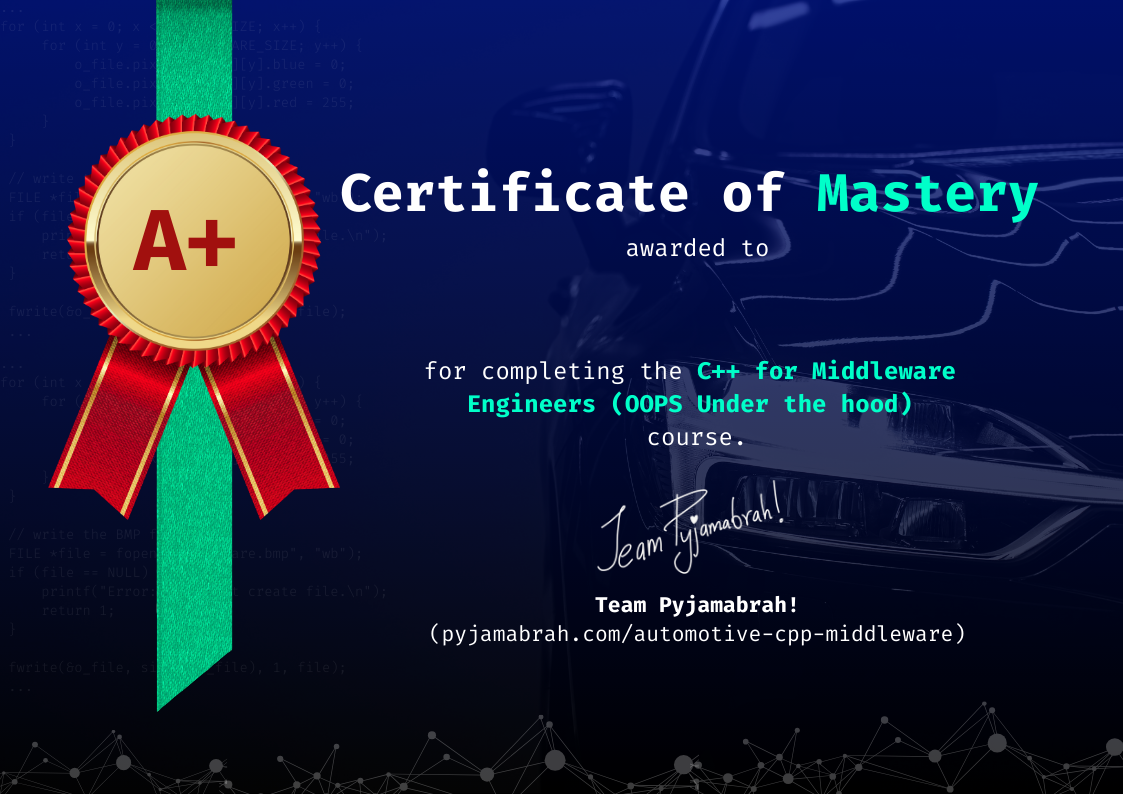
What you see above is a sample certificate. The design of this certificate will be modified from time to time to make it more shiny and reflect the rightly earned pride!
There will always be a dedicated certificate identification number to verify it with us. This should enable anyone to check the authenticity of the certificate.
How this is different from Others
| Feature | Us! | Others |
|---|---|---|
| Focus on Internals, Not Just Syntax | ||
| Complete Build Pipeline Coverage | ||
| Binary-Level Learning | ||
| Assembly-Oriented Understanding | ||
| Embedded and Middleware Relevance | ||
| Tool-Driven Engineering Approach | ||
| Memory-Centric Teaching | ||
| Performance-First Mindset | ||
| Mental Model Development | ||
| Production-Oriented Problem Solving |
Instructors

Requirements
Who this course is for
FAQs
This course is created and delivered by a partner who is not a core member of the Pyjama Cafe team. We need to compensate the partner based on the sales of their content.
Is this recommended for beginners?
Yes! The courses are taught as if the learner has no idea about the subject.
Do I need a special machine configuration to take this course?
No!
Can I change my email-id post purchase?
As much as we'd like to support that, your account will be linked to your email-id post purchase.
What name will be printed on the Certificate?
The name you use on the platform will be printed as is on the Certificate when it is generated.
A deep dive into how C++ works under the hood.
Read more...
!!